Summaries were generated by AI. Generative AI is experimental.
Explore other styles:
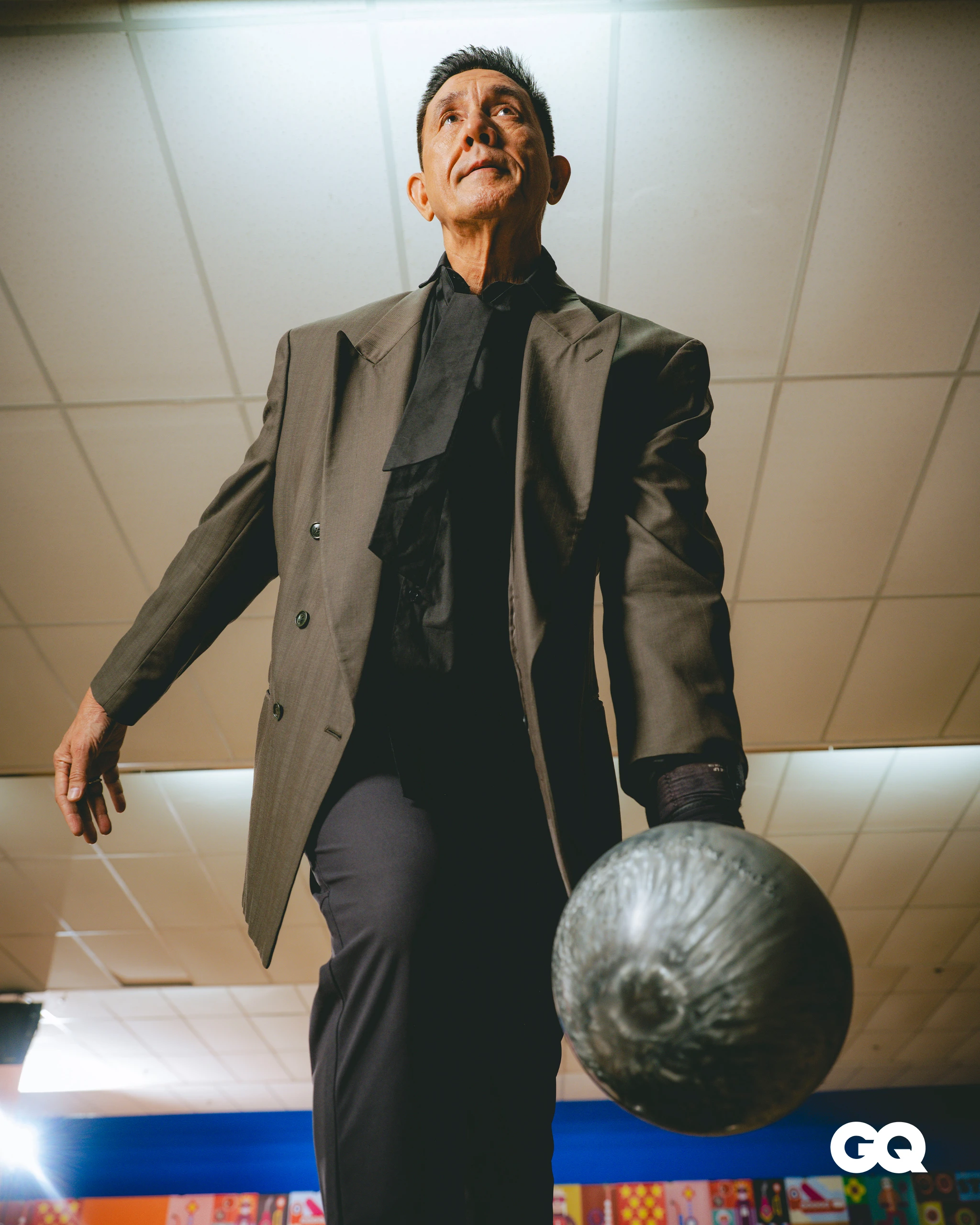
Everyone in the room goes completely still as bowling legend Paeng Nepomuceno winds up to take a shot. Cameras and crew have gathered around him, but there’s a line none of us are willing to cross; we hold ourselves back, giving him the space to do his thing. As he takes his first few steps forward, we all share one collective held breath, the tension in the alley mounting.
The silence is broken when the ball hits the floor. It rolls fluidly across the lane, then crashes into the pins.
One pin is left standing.
Paeng steps back and reads the lane stretching out before him. Despite being filmed and photographed, his eyes stay focused and calculating. Earlier that day, he’d explained to me that every bowling lane is oiled differently; no two are ever the exact same, and a bowler must adjust to changing conditions. Through the decades he has spent in the sport, across an astounding 137 career titles, this truth is the one thing that has remained consistent.
He walks back to the return machine, and this time, chooses a different ball.
The cameras are ready. The rest of us sit on the edges of our seats. He approaches the foul line, his arm swing smooth and practiced, and releases the ball in a single, unbroken motion.
A picture-perfect strike.
Those of us watching exchange glances, wearing the same look of astonishment. We know we just witnessed something special: a six-time World Cup champion, showing us mere mortals how it’s done.
He turns around, this time with a satisfied smile on his face. I ask him how many times he’s scored a perfect 300 game in his career.
“Thirty-eight,” he replies, without missing a beat.

For most people, for whom bowling is a fun game to play with friends over snacks and drinks, it may be easy to assume that Paeng Nepomuceno, who has won multiple World Cup titles across three different decades, would knock down all ten pins every time with ease. Admittedly, even I showed up assuming the same thing, especially here at Paeng’s Gateway Bowl, which is essentially his “home court.”
But in reality, perfection in bowling—though it is possible, as he has proven himself 38 times over—does not come easily.
He shrugs. “That’s what makes me work harder.”
Even at 69 years old, even as he holds the Guinness World Record for the most bowling titles won overall, Paeng Nepomuceno shows up to the lane every single day, still chasing something new.
A Stroke of Fate
It’s 10 a.m. on a Friday. Gateway Mall has just opened, but already, the lanes and billiards tables at Paeng’s Gateway Bowl are starting to fill up. I spot some of the players on the opposite side looking over, curious about the commotion in this closed-off section of the alley. The cameras and lights alone might have already drawn attention to Paeng—that, and his six-foot-two stature, which is hard to miss in any room. But if those hints were not enough, his trophies, carried in one by one through the glass doors, would have been a dead giveaway.
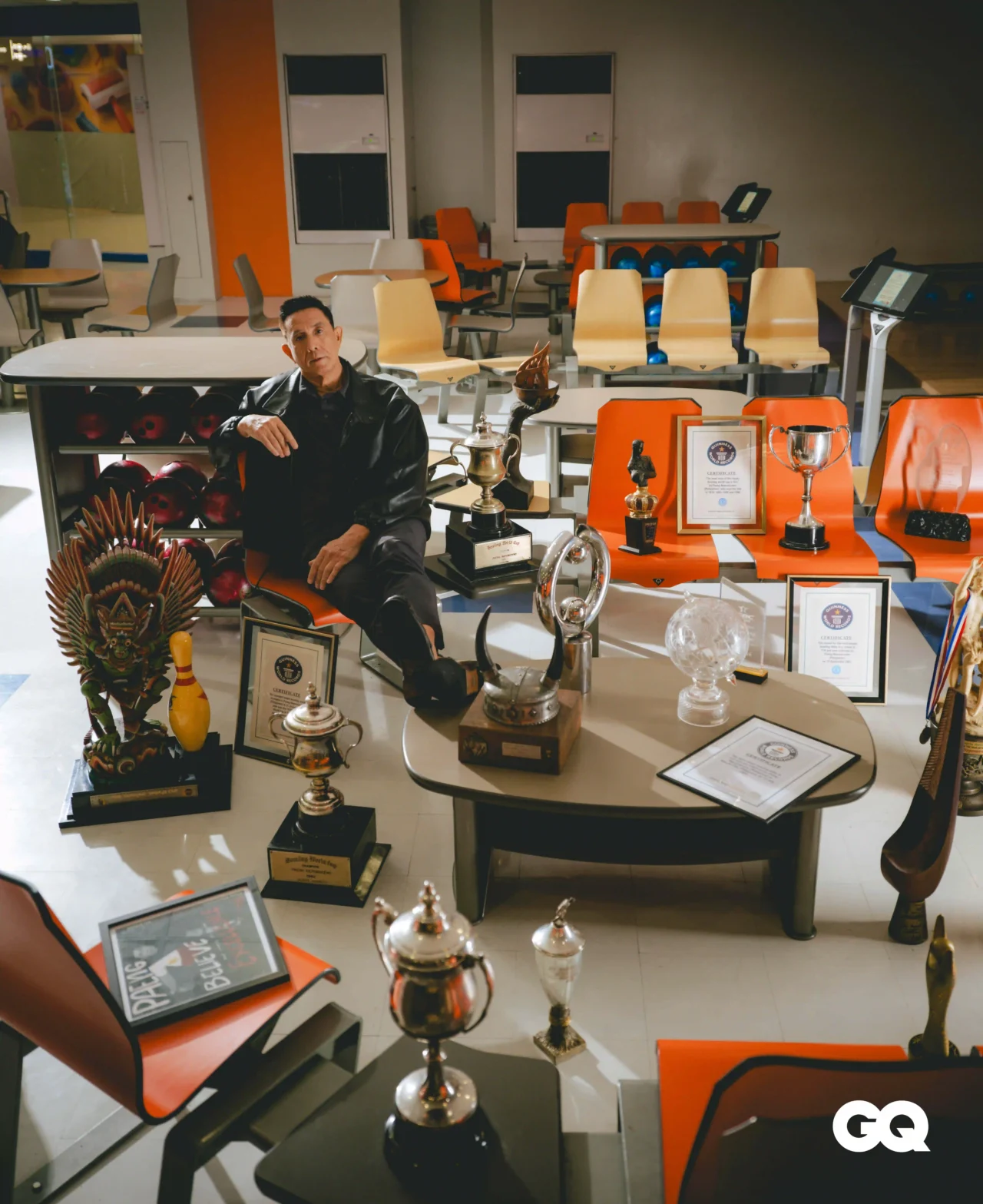
Paeng normally keeps these awards in a trophy room at home, though he admits that not all 137 of them fit. “Mostly, [the trophies on display] are the important ones. All the rest are either in storage or displayed somewhere else.”
The few he’s brought to the alley today are among his most iconic, and we’re fortunate enough to get our own private tour. He stands next to a large ornate trophy that resembles the mythical bird known as the Garuda, which was awarded to him at the 1980 AMF Bowling World Cup in Jakarta, Indonesia. Then there’s his Athlete of the Century Award, given to him by the Philippine Sportswriters Association in 1999. Finally, he points out his four Guinness World Records. “Three of them are still unbeaten,” he adds.
It’s hard to believe all this (and more) came about from a small chance encounter that, in hindsight, seems almost mythical. It was a rainy day in Baguio, and Paeng was out at Camp John Hay with his dad. Needing to take shelter from the weather, they decided to wait it out at the Mile High Bowling Center and pass the time by playing a few games. He was only ten years old then, and it was a simple, brief introduction to the sport that may not have even happened if the sun had been shining.
“I think it was more of fate,” he reflects, “because if not, I would not have discovered bowling.”
It was that small seed that gave way to something even sweeter than fiction, although the truth behind his remarkable successes was far from plain sailing. The challenge back then was that, as Paeng explains, “There was no organized coaching.”
Yet he knew that, despite the limitations, he wanted to be a bowling champion. Thus, it became a family affair; his father, Angel Nepomuceno, took the reins and became Paeng’s coach. He even imported books on bowling from the United States to help his son meet the standards of international competition. “It’s different if it’s your father as your coach. It’s a lot of dedication,” he shares.
But he emphasizes, “You have to trust. A lot of kids can’t really work with their dad…It’s hard to assign their dad as a coach. For some, their mindset is, ‘I’m better than him in playing. Why should he teach me?’”
“I had a skill for bowling, so I made his coaching a bit easier.” He chuckles. “But I know that the role of a coach is different. You don’t need to be a really good player; it’s more having an analytical mind. I understood that…It’s the mind, and having good eyes, observing, and decision-making.”
Looking back now, Paeng recognizes that this actually gave him an edge when he started competing against some of the most talented players in the world. Having built a foundation from scratch, he also developed a razor-sharp inquisitiveness for the game. To this day, he still starts every training session by working on the gaps in his game (if you can believe that a multi-titled world champion might even have any left).
This is the wisdom he tries to impart to younger bowlers today, now as a coach and mentor. “You need to enjoy the journey. Take it step by step, take it as it goes. Train for it. Obstacles come your way—but just work on it.”
Easier said than done, one might think. But for Paeng, it was both. When it comes to putting in the work, it’s easy said, easy done.
Easy Does It
Among the silverware laid out on display, Paeng singles out his first-ever World Cup trophy, which he won in 1976. That was a big year for his career; in the span of six months, he won the National Championship, the Asian Championship, and his first-ever World Cup title.
He beams, standing next to the award, whose silver has lost some of its luster over time. “This one is turning fifty this year,” he says.
The bowling star was only 19 years old when he first lifted this trophy, becoming the youngest World Bowling Champion, a record he still holds today. At the time, FilipinoFilipinoThe national language of the Philippines, widely used for communication, education, media, and culture.Go to Filipino Glossary world champions were a much rarer breed than they are today, and that made his victories on the global stage all the more newsworthy. Not only did he put the Philippines on the map, but he also legitimized bowling as a competitive sport in the Philippines.
As a teenager, however, Paeng himself did not yet grasp the magnitude of his wins.
Reflecting on his 1976 World Cup victory, admits, “I just wanted to do a respectable finish. I was the best in Asia, but on the world stage, I didn’t have an idea of the competition. I was only 19.” He chuckles. “If you remember when you were 19…it’s different. At 19, you want to party, and ‘di pwede yun sa sports.”
When asked if that was a struggle for him, having to sacrifice youthful indulgences, he shook his head plainly.
“I really wanted to be champion, and I knew what it took. I knew I had to make sacrifices.”
Paeng traveled often for competitions throughout his career, and had many opportunities to enjoy the glitz and glamor of globetrotting, yet his eyes were always more naturally drawn to a different kind of opulence: winning.
For him, that meant no TV, no shopping, no late nights. “There were many tournaments where I’d just see the bowling center and the hotel. Although it’s good to enjoy (those things), this was just my preference.”
This willpower translated to a laser-like focus on game days, unflinching even when his mettle was tested, and this is what truly gave him his edge. While other players might have succumbed to the pressure of playing on the biggest stages against the toughest opponents, Paeng quickly learned how to block out the fuss and fanfare.
“I had to psych myself to be that way. I think that’s the number one criterion of the mental game: to be cool, calm, and collected.”
As a coach now, he emphasizes, more than anything, the importance of mental fortitude. “All athletes have the same skill,” he explains. “A guy who is able to control his emotions, his nerves—he’s the better player. In sports, it’s all about nervousness, controlling it. You see in basketball or golf, they miss easy shots in crucial moments, but in practice, they never miss.
“I’ve seen a lot of bowlers in all my competitions. Some of them are physically better than me, but when the finals come, the TV lights are on, spectators are there; if they’re nervous, they commit mistakes…My forte is I have a mental game.”
Easier said than done, you might think. But if his career has been any indication, it’s that if Paeng sets his sights on a strike, one way or another, he’ll make it happen.
A Champion, Unfinished
Fifty years since his breakthrough season, and Paeng Nepomuceno has yet to put the ball down for good. Decades deep into the sport, bowling remains a steady part of his routine.
He walks us through a day in his life at 69: “When I wake up, I have breakfast. I work out. And then I attend to our business in the mornings. After lunch, I’m either practicing or going around to my different bowling centers. I also teach; I give personalized lessons.”
These days, Paeng splits his time between the lane and the sidelines. He still competes while also coaching young bowlers and certifying aspiring coaches across Southeast Asia. He spent three years leading the Philippine National Bowling Team as well. “My coaching is more like giving back,” he explains.
For many athletes, coaching is a common next step after retirement. But Paeng, who will be turning 70 in January, hasn’t withdrawn from competition entirely. As he puts it, he’s only “semi-retired.” This, he explains, is the perk of being a bowler: it’s a sport you can continue to play well into your old age as long as your faculties allow it.
However, he does concede, “Of course, your skill diminishes.” He stretches out his arm to show me the proof: a scar on his wrist, left behind by years of wear and tear and surgery.
And yet, he still wins. Just last April, he won his 137th career title at the DATBI-CSI Open Senior Masters in Quezon City. This is a man with nothing left to prove, but he continues to demonstrate what truly makes him one of the greatest FilipinoFilipinoThe national language of the Philippines, widely used for communication, education, media, and culture.Go to Filipino Glossary athletes.
“What makes it different is the challenge. We play different playing conditions, and the challenge these days is keeping up with the younger ones. That’s what keeps me going. The sport is evolving, always evolving. Different equipment, technology, the pins, the oiling machine…It challenges us.”

For Paeng, the more things change, the more things stay the same. He does not believe he has mastered everything, even now, and his curiosity-driven approach to the sport has brought him back to the lanes time and time again. It is why he keeps winning, why his records remain unbroken.
“That’s one thing I had to do: reinvent myself,” he says. “If I stuck to my same style and all, I would have been a one-time champion.”
But Paeng Nepomuceno is anything but a one-hit wonder.
Looking over the awards he’s brought with him for the day, I ask him if winning now feels the same as it did back then, when he was gunning for world titles. He takes a moment to think, then shakes his head.
“Every win is a special win. It’s still important, whether it’s a small tournament or a big tournament,” he says.
His reputation precedes him. He’s the kind of famous person who gets your name in a children’s textbook. And yet, somehow, he remains as modest as ever—a true-blue, lifelong student of the game.
He glances one last time at the trophies laid out before him. “I don’t even mind them anymore,” he says with a cheeky grin.
“Don’t rest on your laurels.”
A version of this story appears in the September 2026 issue with the title “Last Pin Standing”
SHOOT CREDITS:
Story by ANNIKA CANIZA. Photographs by SHAIRA LUNA. Groomer: NEAL ALLEN LAUREANO. Photo Assistant: KARLO BAYLON & EMELITO LANSANGAN. Producer: KEVIN GONZALES. Art Direction: MARC YELLOW. Location: PAENG’S GATEWAY BOWL.
Frequently Asked Questions
Paeng Nepomuceno holds 137 career titles, including a Guinness World Record for the most bowling titles won overall, with his most recent win coming in April 2026 at a senior tournament.
He took shelter from the rain at a bowling center in Baguio with his father at age 10, and what began as a chance activity during a downpour turned into a lifelong career.
His father, Angel Nepomuceno, coached him despite having no formal bowling background, even importing training books from the United States to help his son meet international competition standards.
At 69, Paeng Nepomuceno calls himself semi-retired but continues competing, winning his 137th career title as recently as April 2026 at the DATBI-CSI Open Senior Masters in Quezon City.
Paeng Nepomuceno won his first World Cup title in 1976 at just 19 years old, becoming the youngest World Bowling Champion at the time, a record that he still holds today.