Summaries were generated by AI. Generative AI is experimental.
Explore other styles:
The barong Tagalog, as interpreted by contemporary designers, might seem like a completely different piece of apparel from what it was in its 16th-century origins. Long before Spain colonized the Philippines, Filipinos were already wearing the badu—a simple shirt with a hem that reached the wearer’s mid-thigh.
Through Christianization, Hispanization, and the passage of time, the badu gradually evolved to the baro, incorporating Western elements such as collars, cuffs, and embroidered patterns on the chest, known as the pechera (shirt front).
“By the end of the 19th century, the baro had assumed the look it has today—a shirt of piña or jusi, half-open and buttoned in front up to a small collar, with long, loose sleeves ending in buttoned cuffs,” said cultural advocate and Gawad CCP awardee Dr. Nicanor Tiongson during a special lecture at the De La Salle-College of Saint Benilde last November.
He noted that Philippine presidents throughout the 20th-century proudly wore the barong to their inaugurations. For instance, the pechera of President Manuel L. Quezon’s barong at his 1935 inauguration featured the embroidered flags of the Philippines and the United States, symbolizing the Commonwealth era.
Tiongson likewise pointed out how the barong “developed a famed reputation, a nobility” because President Ramon Magsaysay wore it frequently during the mid-1950s. During the administration of President Diosdado Macapagal in the 1960s, a new style emerged known as the “all-over,” in which intricate embroidery, or callado, covered the entire garment. “It was also Macapagal who officially declared the barong Tagalog as the national costume for men,” Tiongson said.
Flights of Fancy
Some designers have taken the broader definition of the barong as a license to express their creativity and produce fanciful pieces. However, scenographer and educator Gino Gonzales believes the barong must retain certain essential elements to still be considered authentic. His non-negotiables? “The pechera, a degree of transparency or the use of lightweight fabric, and its untucked silhouette. Otherwise, how is it different from a dress shirt from Zara?”
One veteran designer who has been creating barongs for decades is Barge Ramos. He recalled how he admired, from afar, the crisp jusi barong worn by his father and his father’s co-workers.
“I think they were my role models when I began designing barong Tagalog,” Ramos shared. Throughout his years of making the garment, however, he has realized that most FilipinoFilipinoThe national language of the Philippines, widely used for communication, education, media, and culture.Go to Filipino Glossary men prefer not to stand out at gatherings.
“The opposite is true for Filipinos living abroad. They always want something more than the usual. I guess it’s a sense of pride in being FilipinoFilipinoThe national language of the Philippines, widely used for communication, education, media, and culture.Go to Filipino Glossary, and seeing other nationalities wear their national costumes at formal gatherings. Filipinos who live abroad are more fashion-forward,” he observed.
For those clients, Ramos experimented by designing barongs with unique features like oversized sleeves. He also silkscreened prints onto jusi and cotton, and applied t’nalak motifs to pastel-colored synthetic jusi. “I wanted to show alternative ways of wearing barongs without the embroidery.”
Despite all his experimentation, Ramos knows that, ultimately, certain traditional elements must be upheld. “Whatever the design, the barong should exude formal elegance. The collar construction is crucial because it frames the face. In addition, the fit shouldn’t be too close to the body, just comfortably loose,” he said.
“Proportion is likewise important. There are strict measurements when making a barong. Absurd designs like the addition of a terno sleeve make me cringe,” he added.
Traditional Tailoring
Ramos decried how some young designers have become “too fashion-forward” in their innovations to the Filipiniana. “The barong Tagalog has evolved so much, but one still has to respect that it is the formal national menswear of the Philippines,” he said.
Gonzales—who is one of the major proponents of the terno through the biennial TernoCon, co-organized by Bench and the Cultural Center of the Philippines—views it differently. He has noted in the past that terno designers must first master the garment’s construction before experimenting; the same principle applies to the barong. Masterful tailoring and construction are essential.
“The designers who have created the most innovative barong began with traditional tailoring techniques. By understanding how the garment has been constructed over time, they learned its conventions and found ways to interpret them for Filipinos today,” Gonzales said.
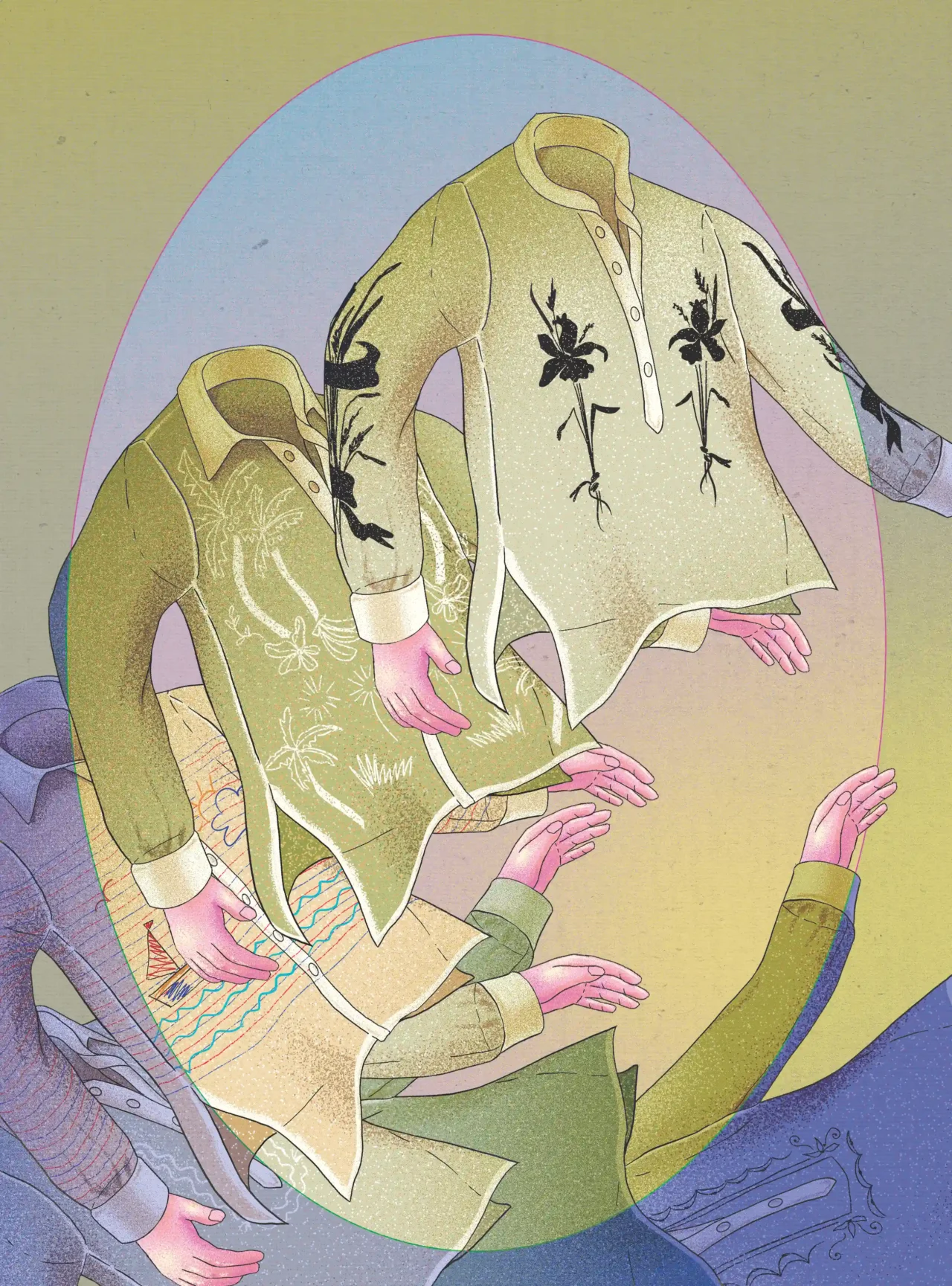
A couple of years ago, several designers began introducing eye-catching barong designs that were fresh and unlike previous iterations. Cebu-based Bree Esplanada’s designs evoked a gothic aesthetic, featuring images of skeletons and the Grim Reaper rendered in dark thread. Happy Andrada showcased bomber- and varsity-jacket-style barongs made from silk cocoon fabric from Laguna, which featured hand-embroidered details like anahaw leaves, tricycles, and jeepneys.
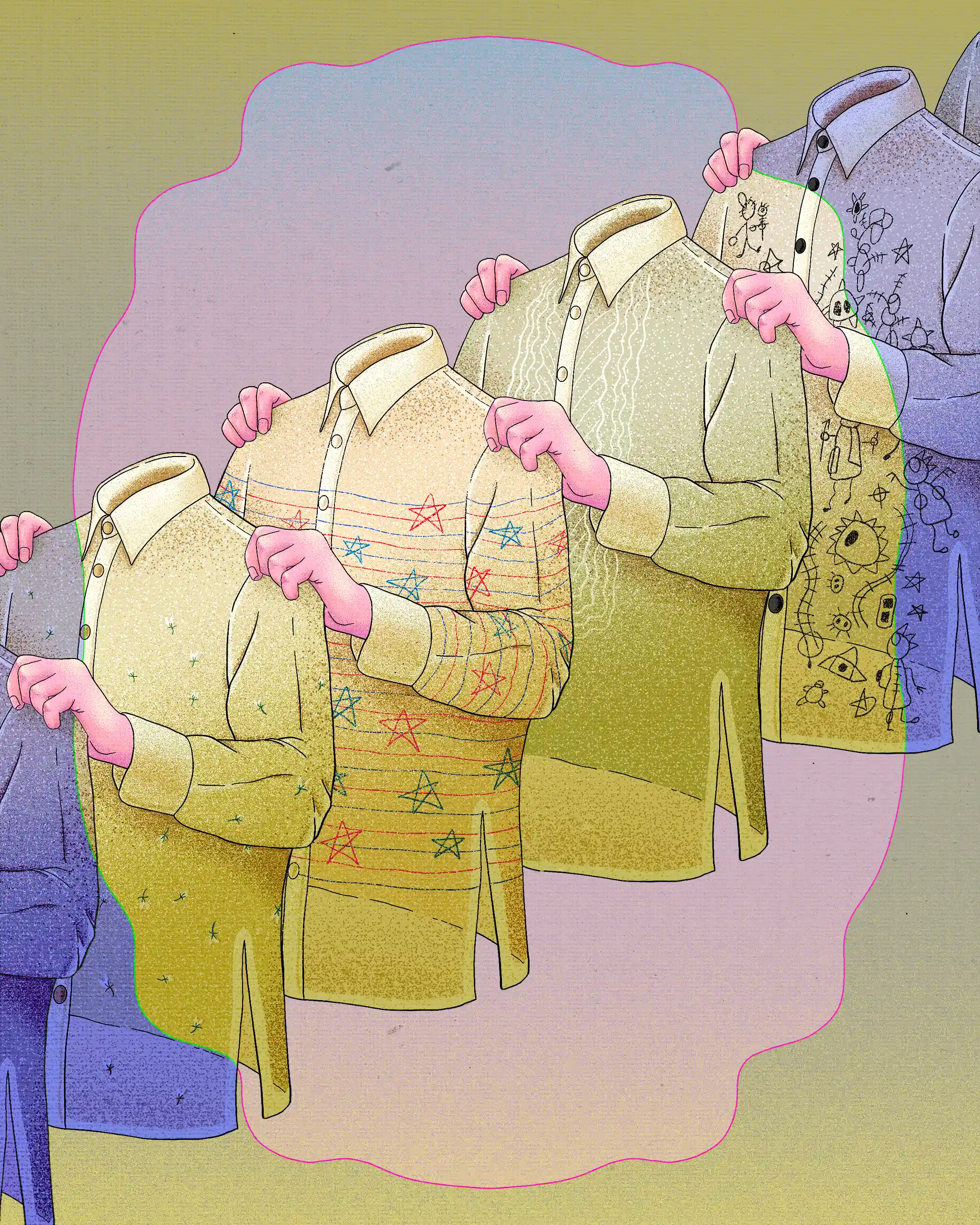
One of the most widely replicated barong designs today was created by Daryl Maat, who reinterpreted childlike scrawls of airplanes and five-pointed stars on fabric resembling lined notebook paper. Edwin Ao, meanwhile, embroidered multicolored doodles, and Gabbie Sarenas showcased barongs adorned with sprigs of flowers, including sampaguita, in studied, deliberate patterns. With the way these designers were experimenting, callado embroidery never knew what hit it.
“Wearables”
Model and photographer-turned-designer Jo Ann Bitagcol has honed her eye after years spent entrenched in the fashion industry. Before the pandemic, she began printing her photographs of barongs, ternos, and other Philippine-related objects on silk satin scarves. This later evolved into gender-neutral apparel that found an audience among individuals who didn’t want to be limited to traditional barong or terno tops.
As her apparel selection expanded, Bitagcol took basic dressmaking and bespoke tailoring classes at Slim’s Fashion and Arts School, as well as draping classes with designer and professor Jojie Lloren at F.A.B. Creatives.
She described her version of the barong as very wearable because they adapt to different times and body types. “We carry the spirit of the tradition through the photographs that we incorporate into our pieces,” Bitagcol said.
While she is aware that her creations are not barongs in the traditional sense, she sees no need to defend herself or her designs. “Times are different. Everything changes and evolves. I have a wide range of clients, each with their own way of expressing themselves and point of view—I answer to their needs accordingly. In my opinion, as long as the intention is to represent our identity in a respectful way, then all forms and versions are welcome.”
Gonzales also has a tip for those wearing a formal barong. He recommends investing in a custom-made, skin-tone undershirt. “Even the most beautiful barong can be undermined by an ill-fitting white T-shirt. Personally, I prefer a black undershirt because it blends with the trousers and makes the embroidery of the barong stand out.”
This diversity of choices can only benefit those considering their options when it comes to the national garment. “Filipinos today are fortunate as barongs are widely available, from Divisoria, SM, and Bench, to online stores, [making it] easy to find one that suits your needs and budget,” Gonzales concluded.
A version of this story appears in the September 2026 issue with the title “The New Barong”
Frequently Asked Questions
The barong Tagalog evolved from the badu, a simple pre-colonial shirt with a hem reaching mid-thigh. Through Spanish colonization, it developed into the baro, incorporating Western elements like collars, cuffs, and embroidered chest panels known as the pechera.
President Diosdado Macapagal officially declared the barong Tagalog the national costume for men during his administration in the 1960s, the same era that introduced the intricately embroidered “all-over” callado style.
According to scenographer and educator Gino Gonzales, an authentic barong requires the pechera, a degree of transparency or lightweight fabric, and an untucked silhouette, distinguishing it from a standard dress shirt regardless of design innovation.
Designers have introduced varied reinterpretations, including Bree Esplanada’s gothic skeleton motifs, Happy Andrada’s bomber-jacket-style silk cocoon barongs, Daryl Maat’s childlike doodle embroidery, and Jo Ann Bitagcol’s photo-printed, gender-neutral “wearables” inspired by traditional Filipiniana.
Scenographer Gino Gonzales recommends wearing a custom-made, skin-tone or black undershirt underneath a formal barong, noting that an ill-fitting white T-shirt can undermine the garment’s appearance, while a darker undershirt helps the embroidery stand out.