Summaries were generated by AI. Generative AI is experimental.
Explore other styles:
There was a time when brewing anything in your kitchen implied a certain kind of dedication—the kind involving complex copper tubing, sanitizing solutions, and an inevitable conversation with your barangay tanod about the smell. Today, the latest home-brewing obsession is far less suspicious. The newest status symbol isn’t a high-end espresso machine; it is a glass jar harboring a strange, translucent organism. We are, it seems, officially brewing our own kombucha.
Kombucha is tea’s fizzy alter-ego: a fermented, probiotic-packed brew that promotes gut health and immunity. This once-niche obsession has sparked a DIY movement, with foodies cultivating and brewing their own kitchen-counter SCOBYs (Symbiotic cultures of bacteria and yeast) to ditch pricey store-bought bottles. Among the people helping drive this movement is Tey Lopez, an agroecology advocate, cultural worker, and team member of Good Food Community.
“I am a fermentation enthusiast and started making kombucha and other ferments in 2020,” Lopez says. Like many, his obsession bloomed during the pandemic, when a friend gifted him a bottle of home-brewed kombucha. “I instantly loved the taste, so I started researching it. The next thing I knew, kombucha and other ferments had taken over our tiny kitchen.”
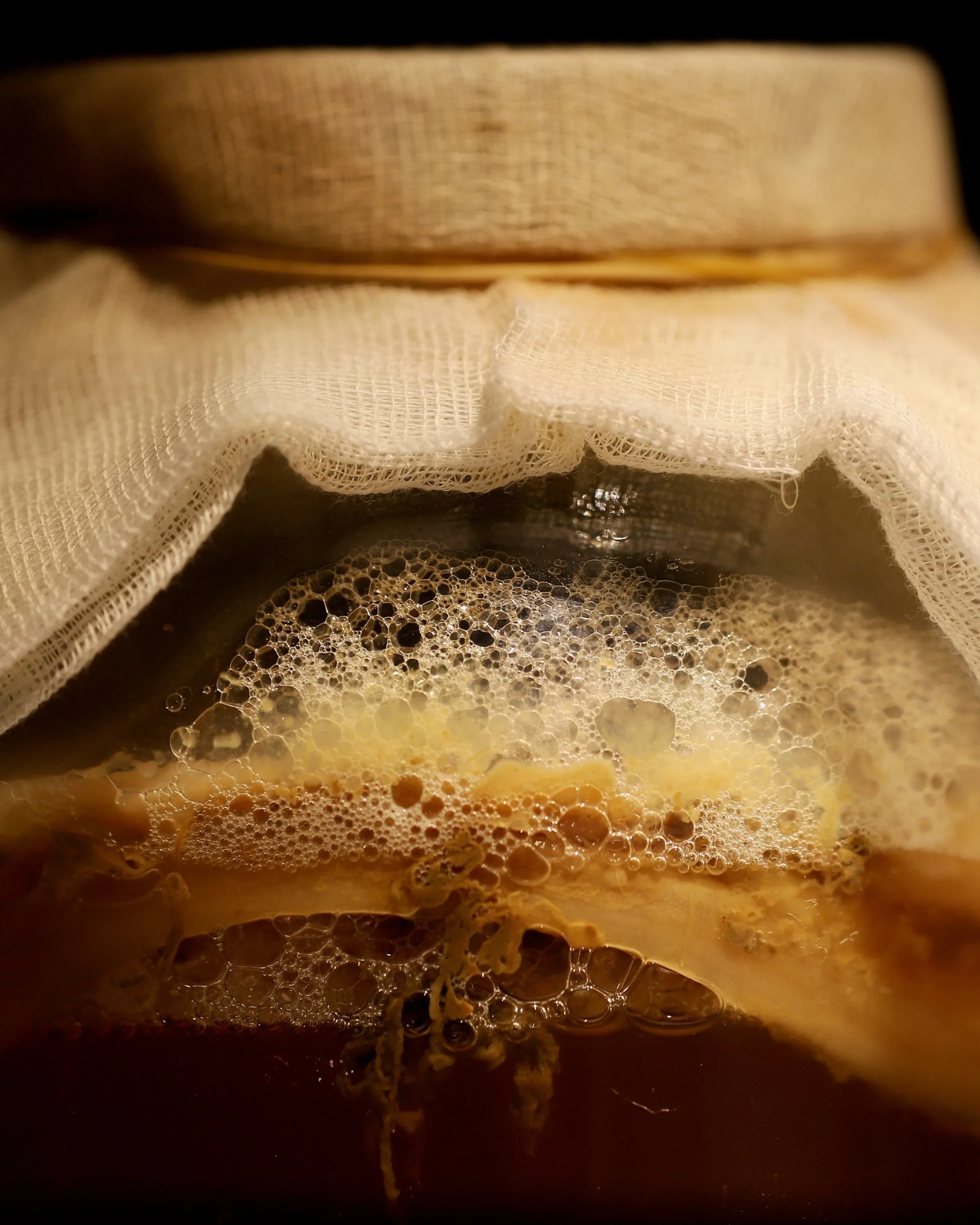
At its core, brewing kombucha is shockingly low-tech: you simply steep sweet tea in a jar with a rubbery, otherworldly-looking disc (the SCOBY) and let bacteria, yeast, and temperature do the heavy lifting. The process feels closer to controlled spoilage than molecular gastronomy.
For the uninitiated, the process can seem intimidatingly scientific, but Lopez insists the learning curve is practically non-existent. “It really isn’t hard. An hour in the kitchen is enough,” he says.
Lopez embraced this hobby and turned it into a small artisanal operation. “I would say I make a hundred bottles a batch. Which I make every two months. So I would say I’m a super micro-enterprise-hobbyist,” he says. He sells his bottles of kombucha to the Good Food Community, which caters to mostly middle-class households and young urban professionals.
Home brewing also makes financial sense. From a purely economic standpoint, commercial bottles begin to feel like a luxury tax. “Let’s put it this way: you can brew your own one-liter bottle at 100 pesos or even less,” Lopez breaks down. “On the other hand, a 250- to 350-milliliter store-bought bottle is priced at maybe 200 to 250 pesos.”
Beyond the savings, home brewing unlocks a level of flavor customization that commercial brands simply cannot match. “Store-bought ones also tend to be sweeter, so if you enjoy the sour or tangy side more, brewing at home is a better option,” Lopez explains. His signature second-fermentation blends are hyper-seasonal, sourcing local ingredients like Taogtog berries, Bauko pear, and tamarillos from organic farmers.
Then there’s the health benefits—primarily live probiotics that support digestive health—which are a welcome byproduct, even if they aren’t the sole motivator. And while the beverage has become a darling of the sober-curious movement, Lopez keeps it refreshingly real about his own lifestyle. When asked if he brews with an alcohol-free life in mind, he laughs. “Definitely not. Beer is still my favorite drink!”
For those ready to claim a square foot of counter space, his advice is simple: “Don’t be scared!” All it takes is filtered water, black tea, white sugar, and a starter liquid to begin. “Fermentation teaches you to be calm, patient, and open to unlimited possibilities,” Lopez reflects. “No two ferments are similar.”
If you’re curious to try your hand at becoming a mix master, Tey Lopez shares with us one of his special concoctions.
The Blueprint: 1-liter DIY Kombucha
The Mix:
1L filtered water
65-85g white sugar
2 organic black tea bags
100-150ml starter liquid.
For the first ferment (F1), follow these steps: Steep and cool sweet tea. Mix with starter liquid in a jar. Cover with a cotton cloth and rubber band. Store in a dark place for 5–7 days. Taste. For the second ferment (F2): Pour into a narrow-neck bottle, leaving 1–2 inches of headroom. Add your choice of seasonal fruit or botanical flavors. Seal tightly. Don’t forget these important instructions: Let carbonation build for 1–2 days. “Be really careful and always burp the bottle in the sink. It can explode and be very messy,” Lopez cautions. Chill before opening.
To get involved in fermentation workshops or source seasonal ingredients, follow Tey Lopez on Instagram at @tvn_kitchen and @goodfoodcommunity.
Frequently Asked Questions
Kombucha is a fermented, probiotic-rich tea made using a SCOBY (symbiotic culture of bacteria and yeast). People are brewing it at home to save money compared to store-bought bottles, customize the flavor and sweetness, and access the gut-health benefits of live probiotics.
According to fermentation enthusiast Tey Lopez, a homemade one-liter bottle of kombucha costs around 100 pesos or less, compared to roughly 200 to 250 pesos for a much smaller 250- to 350-milliliter store-bought bottle.
A basic one-liter batch requires filtered water, white sugar, organic black tea bags, and a starter liquid. The tea is steeped, cooled, and combined with the starter liquid in a jar, then left in a dark place for five to seven days for the first fermentation.
Kombucha contains trace amounts of alcohol as a natural byproduct of fermentation, though it’s generally considered non-alcoholic in typical servings. Fermentation enthusiast Tey Lopez notes he brews kombucha for the flavor and process, not as part of an alcohol-free lifestyle.
Tey Lopez is an agroecology advocate, cultural worker, and fermentation enthusiast affiliated with Good Food Community. He began brewing kombucha in 2020 and now sells small-batch bottles flavored with seasonal, locally sourced ingredients like Taogtog berries and Bauko pear.

Peejo Pilar
With nearly two decades of production and publishing experience, managing editor Peejo Pilar runs GQ Philippines' daily operations like a finely tuned Wacky Races car engine—aligning and collaborating with writers, editors, and creatives. He assists the editor-in-chief and deputy editor in overall management and editorial campaigns as well as keeping the storytelling efficient and sharp, proof that you can manage creative chaos without losing your mind. You can contact him at [email protected].