Summaries were generated by AI. Generative AI is experimental.
Explore other styles:
In Pasig, there’s a spot by the river that is just wide enough for a full basketball court. It used to be no more than a spare slice of concrete sandwiched between the road and the skyway, but ask anyone around Barangay Pineda and they’ll tell you it’s the best place in the neighborhood to play pickup.
Known simply as the Bridge Court, it has become much more than a place to shoot hoops. Children spill onto the floor as soon as classes end. Office workers stop by after dark to squeeze in a game before heading home. Others never touch a basketball at all, choosing instead to sit courtside, catch up with neighbors, or watch whoever’s next.
The local government eventually took notice, renovating the space to make it safer and easier to play on. Like countless barangay courts scattered across the country, it has evolved into something that far exceeds its original purpose. It is a community center without walls, where the rhythms of everyday life unfold one possession at a time.
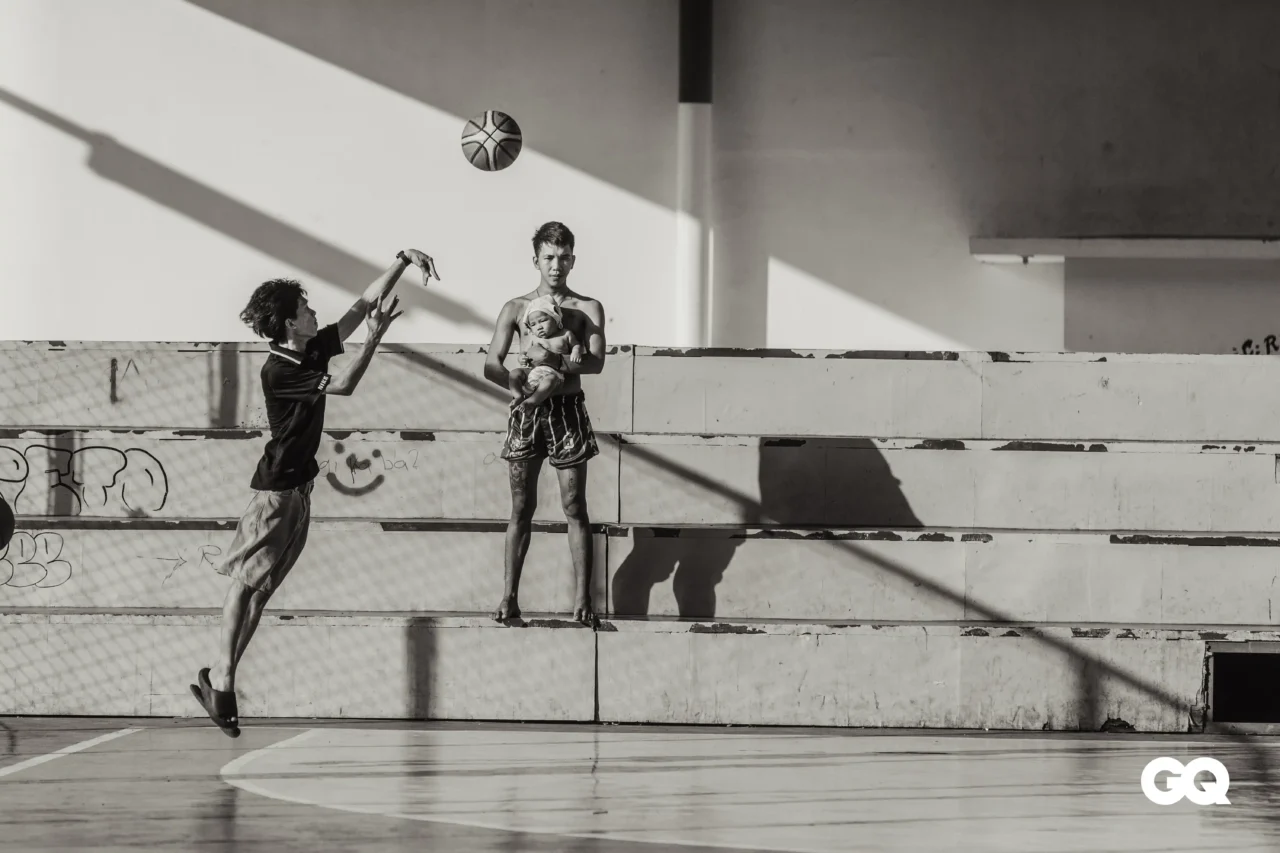
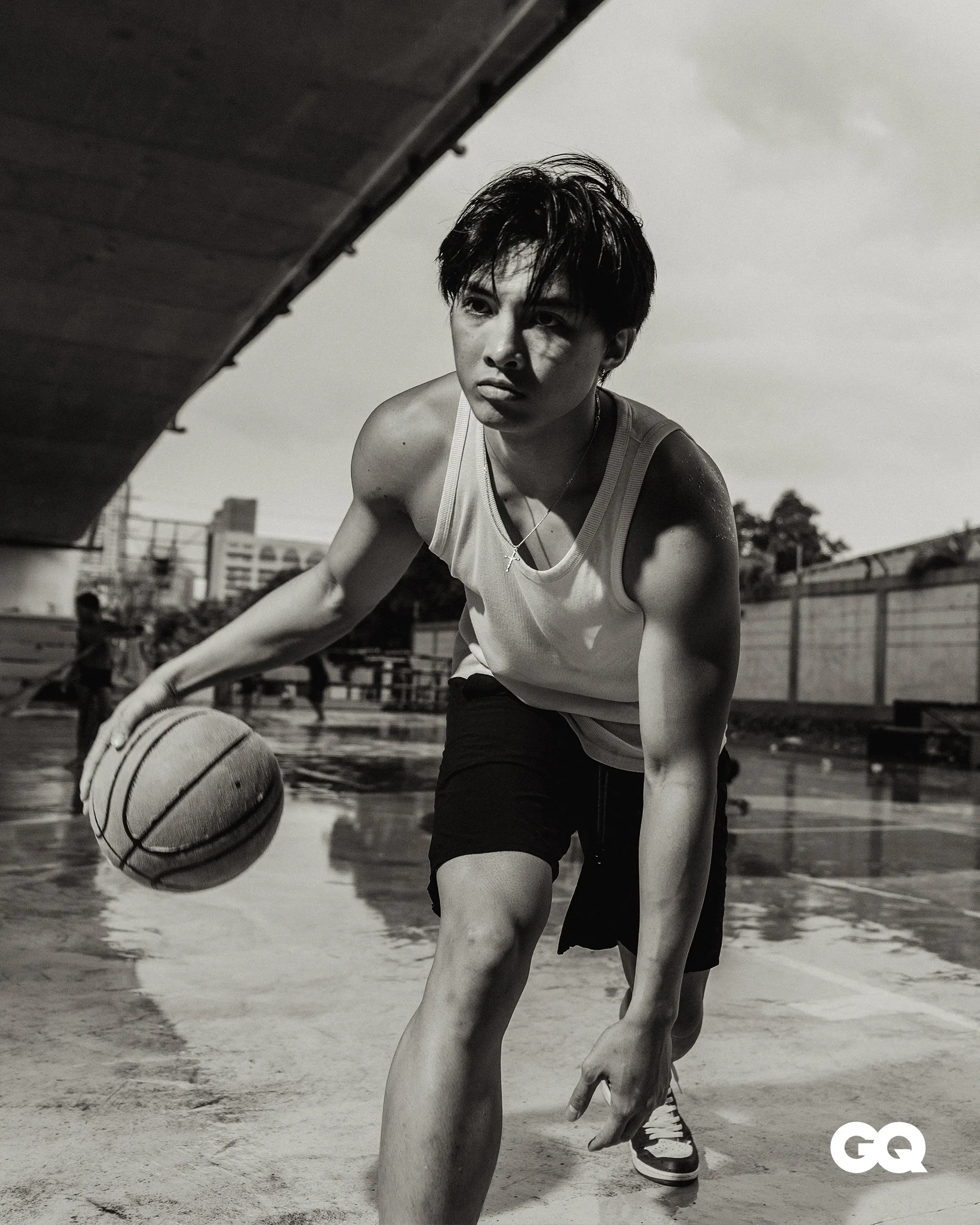
On a blustery afternoon in June, the familiar sound of bouncing basketballs briefly competes with camera shutters as GQ Philippines meets San Juan Knights guard Harold Alarcon. Schoolchildren gather around the sidelines, curious about the professional player visiting their neighborhood court, while a pickup game continues uninterrupted at the opposite end. No one waits for the photos to finish before calling “Next!”
For Alarcon, the scene feels familiar. Before arenas, television broadcasts, and packed collegiate gyms, basketball looked exactly like this to him. “I started to love basketball in the province,” he says in Tagalog. “[In our barangay,] the courts were concrete—the flooring was all concrete. Province life was simple like that; you just needed a ring and a court, and that was good enough to play in.”
The details of his childhood are strikingly ordinary. There were no polished hardwood floors, no private trainers, and no state-of-the-art facilities. There was only enough space for a hoop, a ball worn smooth from years of use, and children willing to play until darkness forced them home. It is a scene repeated across thousands of neighborhoods from Batanes to Tawi-Tawi, one that journalist Rafe Bartholomew came to recognize while reporting for his book, Pacific Rims: Beermen Ballin’ in Flip-Flops and the Philippines’ Unlikely Love Affair with Basketball. His conclusion was simple: the story of Philippine basketball isn’t really found inside professional arenas or beneath championship banners. It lives on neighborhood courts, where basketball has become inseparable from the country’s social fabric.
That distinction matters because basketball arrived in the Philippines under American colonial rule at the turn of the twentieth century, introduced through public schools alongside a broader campaign to reshape FilipinoFilipinoThe national language of the Philippines, widely used for communication, education, media, and culture.Go to Filipino Glossary society. Historians have long noted that colonial administrators expected sports to cultivate discipline, teamwork, and American values among their new subjects. Yet somewhere between the classroom and the barangay, the game escaped those intentions. Filipinos embraced basketball with an enthusiasm few could have anticipated, transforming a colonial import into something unmistakably local.
Anthropologist Michael Tan, whom Bartholomew cites in Pacific Rims, argues that basketball eventually became more than a pastime for young FilipinoFilipinoThe national language of the Philippines, widely used for communication, education, media, and culture.Go to Filipino Glossary men. It evolved into a rite of passage, a place where friendships are forged, alliances are built, and social boundaries become surprisingly porous. On the court, a person’s family name, profession, or social class often matters less than whether they can set a screen, knock down an open jumper, or stay composed when the game is on the line.
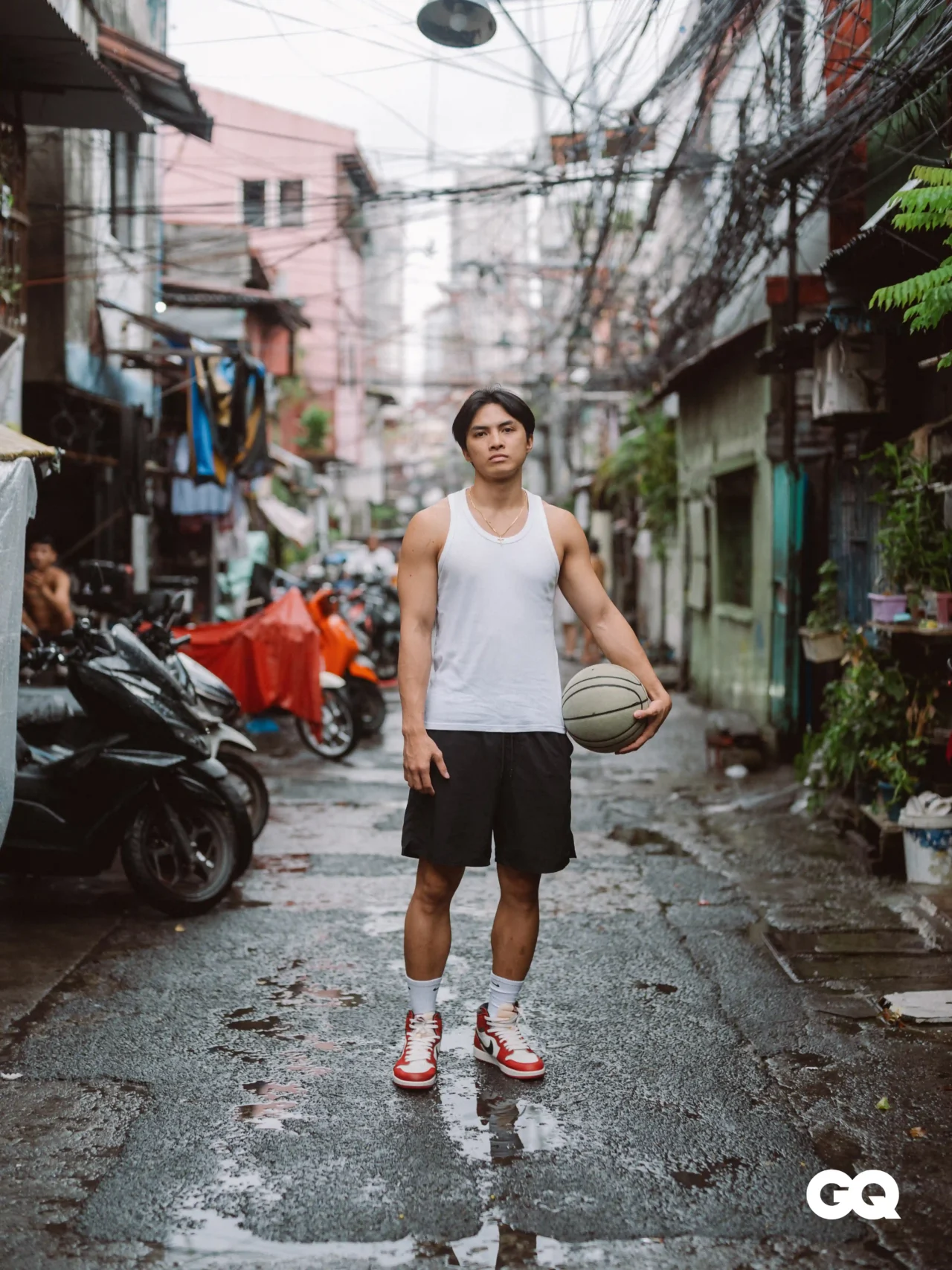
Spend enough time at Bridge Court, and Tan’s observation becomes easy to understand. Children who arrived from different schools instinctively form teams. Fathers still wearing office slacks guard teenagers in slippers. Neighbors drift in and out of conversations without ever stepping onto the court. Others simply lean against the fence, content to watch. Basketball becomes an excuse to gather but rarely the only reason people stay.
Photographer Jake Verzosa arrived at a similar realization after more than a decade of documenting basketball courts across the Philippines. In 2010, he started photographing courts while traveling for editorial assignments, initially drawn to them because they seemed to appear in every corner of the country. Over time, the project grew into an archive of more than a hundred courts, stretching from densely populated cities to isolated mountain villages.
“What I noticed during all my travels was that the basketball court is the most public place in every barangay,” he says.
The courts themselves fascinated him as much as the communities surrounding them. In Kalinga, he photographed one built from hard-packed earth, plywood, and bent sheets of iron, fashioned from whatever materials were available. Elsewhere, he encountered courts squeezed beside highways, overlooking coastlines, or standing quietly beside cemeteries. Unlike the standardized facilities common elsewhere in the world, these spaces often reflected the ingenuity and limitations of the communities that built them. “So it says a lot about the community that built the courts,” Verzosa explains.
His observation echoes one of Pacific Rims’ central ideas: FilipinoFilipinoThe national language of the Philippines, widely used for communication, education, media, and culture.Go to Filipino Glossary basketball has never depended on ideal conditions. The game flourished because communities adapted it to whatever space and resources they had. A backboard could be cut from plywood, a rim welded together from scrap metal, and a vacant lot could become the center of neighborhood life.
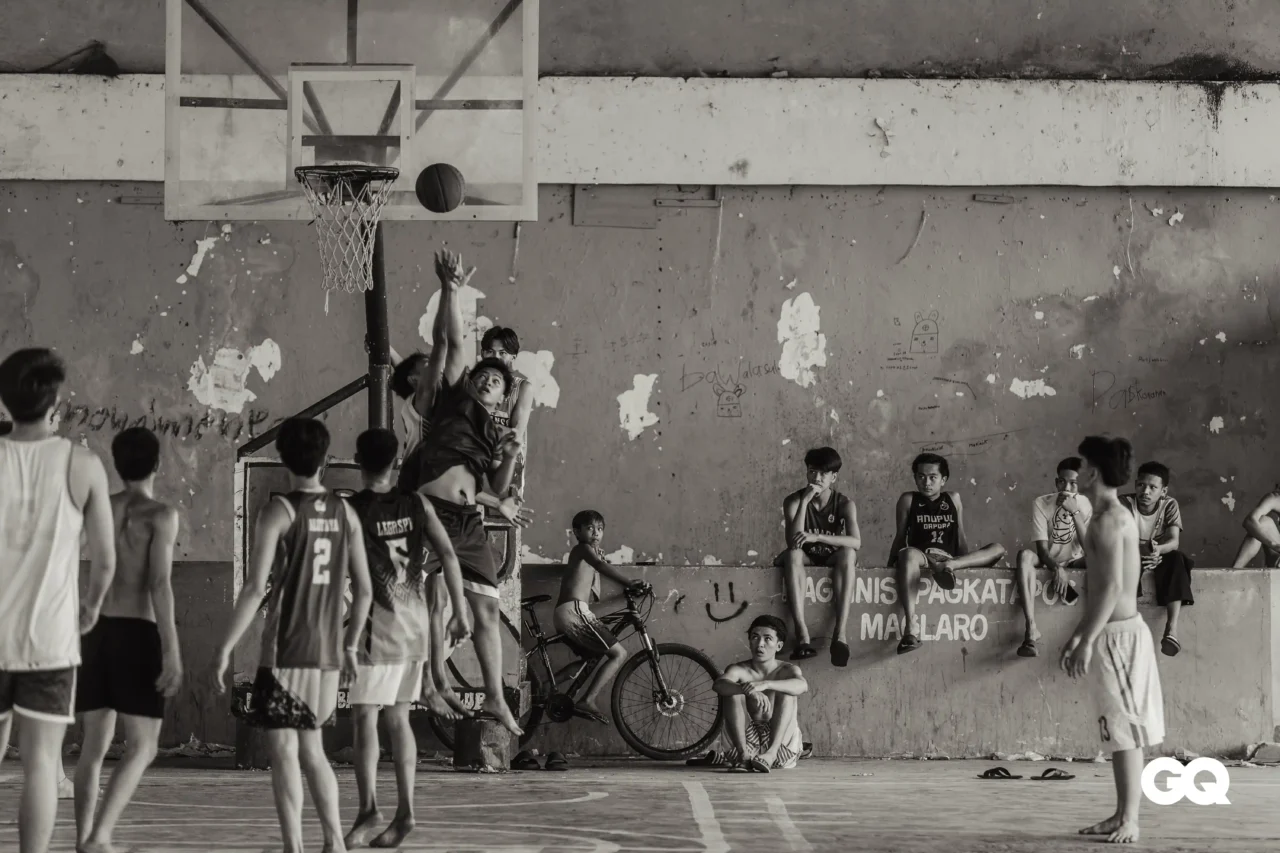
Alarcon knows that reality intimately. “So my motivation back then was, ‘I need to win to fill my stomach,’” he recalls. “We’d always place bets when we’d play. My family didn’t have a lot of money, so playing basketball [and winning] was a way I could earn money, so that I didn’t have to ask more from my parents.”
“And every time we’d win, it was almost automatic. I’d get myself an Angel’s Burger and a Mountain Dew as a reward,” he laughs.
The story is charming, but it also reveals why the sport has remained such a powerful force in the Philippines. For generations of young Filipinos, the game has represented far more than recreation. Barangay tournaments offer prize money, high school recruiters scour provincial leagues for overlooked talent, and athletic scholarships create opportunities that many families might otherwise never afford. The odds of reaching the professional ranks remain vanishingly small, but that has never diminished the game’s appeal. Hope has always been part of the game’s currency.
But Alarcon is one of the few fortunate ones. The reality is that this paradox has never been lost on Filipinos. Basketball is the country’s most beloved sport, yet it is also the one in which Filipinos are constantly reminded of their physical disadvantages. Every FIBA tournament revives familiar conversations about height, size, and whether the nation would be better served by directing its passion elsewhere. Logic would suggest as much, but culture, however, rarely follows logic.
What Bartholomew ultimately argues is that the Philippines’ relationship with basketball has never been about producing NBA players. It is about what the game makes possible. The court has become one of the few truly democratic spaces left in the country, where strangers become teammates, teenagers compete against adults, and entire neighborhoods gather without the expectation of spending money. In communities where parks and public spaces remain scarce, a basketball court often serves all those purposes at once.
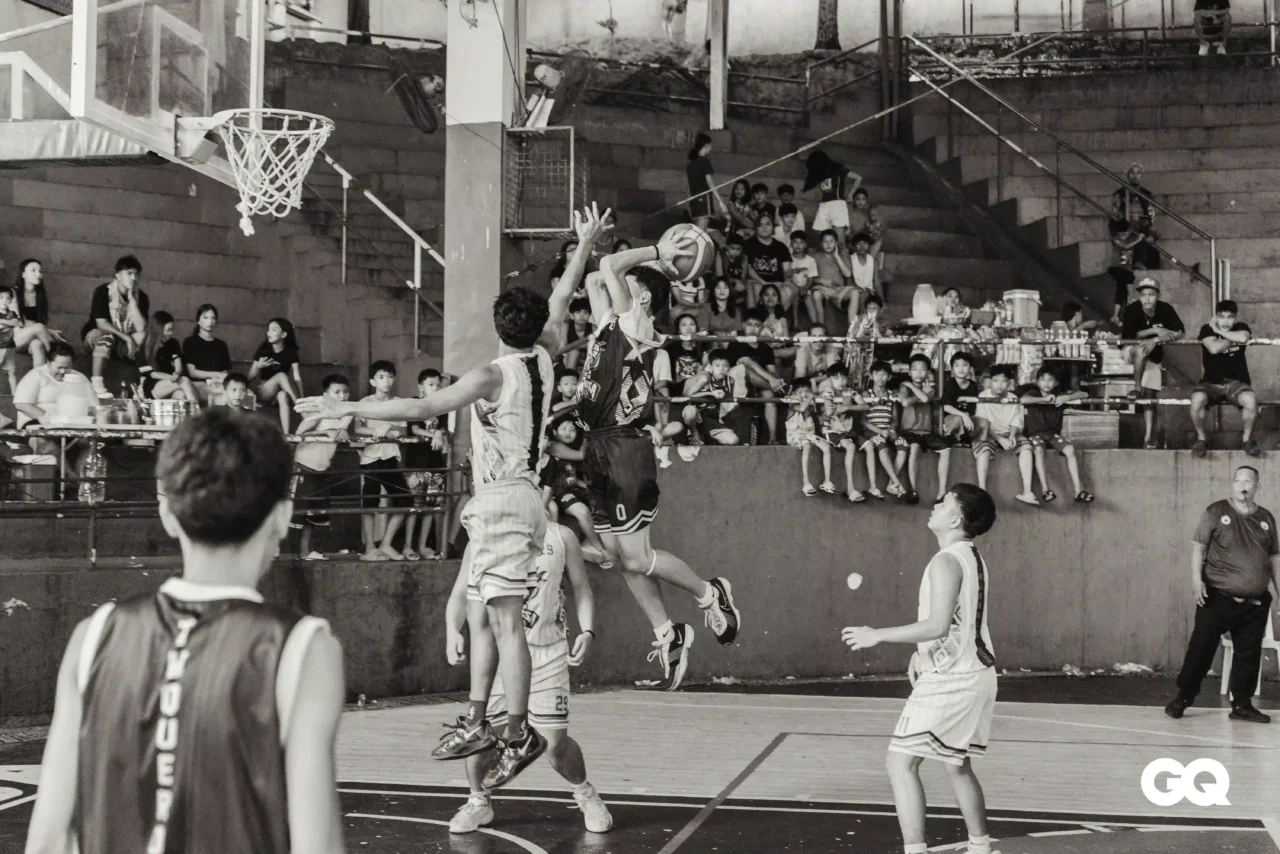
Perhaps that is why, more than a century after the game first arrived on Philippine shores, basketball continues to thrive despite every argument against it. It survives not because Filipinos believe they are destined to dominate the sport, but because they have made it inseparable from the ways they gather, celebrate, compete, and dream.
The children who crowded around Alarcon earlier have returned to the court, arguing over fouls, calling for passes, and laughing as another shot rattles out. One boy dribbles barefoot. Another wears a jersey several sizes too big. A fresh group waits patiently beyond the baseline for the next game.
Most of them will never play in packed arenas, and most will never hear their names announced on television or sign professional contracts. Yet tomorrow afternoon they will almost certainly return, just as the players before them have, because the basketball court has never promised fame. What it has always offered is something both simpler and more enduring: a place to belong.
A version of this story appears in the September 2026 issue with the title “Everyone Loves an Underdog”
Frequently Asked Questions
Bridge Court is a basketball court in Barangay Pineda, Pasig, built on a narrow strip of concrete between a road and a skyway. It functions as a neighborhood gathering space where children, office workers, and residents play pickup games or simply socialize courtside.
Basketball arrived in the Philippines under American colonial rule in the early 1900s, introduced through public schools as part of a broader effort to instill discipline and American values. Filipinos embraced the sport far beyond colonial intentions, making it central to local social life.
Harold Alarcon is a San Juan Knights guard who grew up playing basketball on concrete courts in the province. He has described using basketball winnings as a child to help support his family, reflecting the game’s role as both recreation and opportunity in Filipino communities.
Photographer Jake Verzosa, who has documented more than 100 Philippine basketball courts since 2010, notes that courts are often built from whatever materials are available, reflecting each community’s ingenuity. He calls the basketball court “the most public place in every barangay.”
According to journalist Rafe Bartholomew’s book Pacific Rims, Philippine basketball’s significance isn’t about producing NBA-caliber talent, but about the social function of the court itself, serving as a democratic gathering space where social class and background matter less than the game being played.