Summaries were generated by AI. Generative AI is experimental.
Explore other styles:
Forest-dwelling ghouls. Bestial, baby-like predators. Bisected, airborne viscera-suckers. For almost as long as FilipinoFilipinoThe national language of the Philippines, widely used for communication, education, media, and culture.Go to Filipino Glossary cinema has existed, the paranormal has drifted across its screens. In his 2011 book Film: American Influence on Philippine Cinema, film historian Nick Deocampo notes two of the earliest silent horror films on record: Tiyanak (1926) and Ang Manananggal (1927). Directed and produced by Jose Nepomuceno, considered by many to be one of the founding fathers of Filipino cinema, both films proved to be “big moneymaker(s)” in their time. A few years later, George Musser directed Ang Asuang (1932), the first locally produced partial-talkie.
All known film prints of these works appear to be lost, yet, their very existence in the historical record confirms that representations of paranormal, indigenous folk creatures have been intertwined with the DNA of our national cinema from its beginning. There is, of course, a clear material rationale for the repeated cinematic appearance of the aswang in its many forms.
Writing about the nascent Filipino film industry, Deocampo lays out the studios’ tried-and-tested business strategy: “Studio heads observed which Hollywood films proved to be top grossers, then imitated them.” The horror genre performed well in cinemas across the imperial core, and the formula was subsequently applied in the colony. Early Filipino films of the era weren’t simply afterimages of Hollywood trends, but direct products of American capital, technology, and technical expertise. Musser’s Ang Asuang, for instance, drew from local folklore and starred Mary Walter, one of the defining Filipino horror icons of the 20th century, but was recorded only in Spanish and English.
Recognizing the longstanding imperial influence on our national cinema does not make it any less FilipinoFilipinoThe national language of the Philippines, widely used for communication, education, media, and culture.Go to Filipino Glossary, nor does it require some abstract definition of “Filipino-ness.” Our imperial history and neocolonial present bleed into every facet of life. Our recurring mass curiosity about these uncanny folk spirits predates the arrival of conquistadors and G.I.s. As with all colonial transmissions, centuries under the tropical sun and on native soil spawn something new. The Catholicism brought to the islands by the earliest Jesuit missions from Europe has undoubtedly been transformed through generations of local worship.
Similarly, the appearance of paranormal creatures of the night in FilipinoFilipinoThe national language of the Philippines, widely used for communication, education, media, and culture.Go to Filipino Glossary cinema cannot simply be categorized as Western facsimiles. Centuries of Spanish Christianization and decades of U.S. cultural hegemony failed to quash pre-colonial beliefs like the aswang, a broad figure in Philippine folklore that filmmakers have repeatedly adapted, reshaped, and reimagined across generations. To seriously study spirits is not to abandon scientific thinking, but rather to analyze a system of beliefs that has resisted erasure at every turn.
The Aswang Goes to School
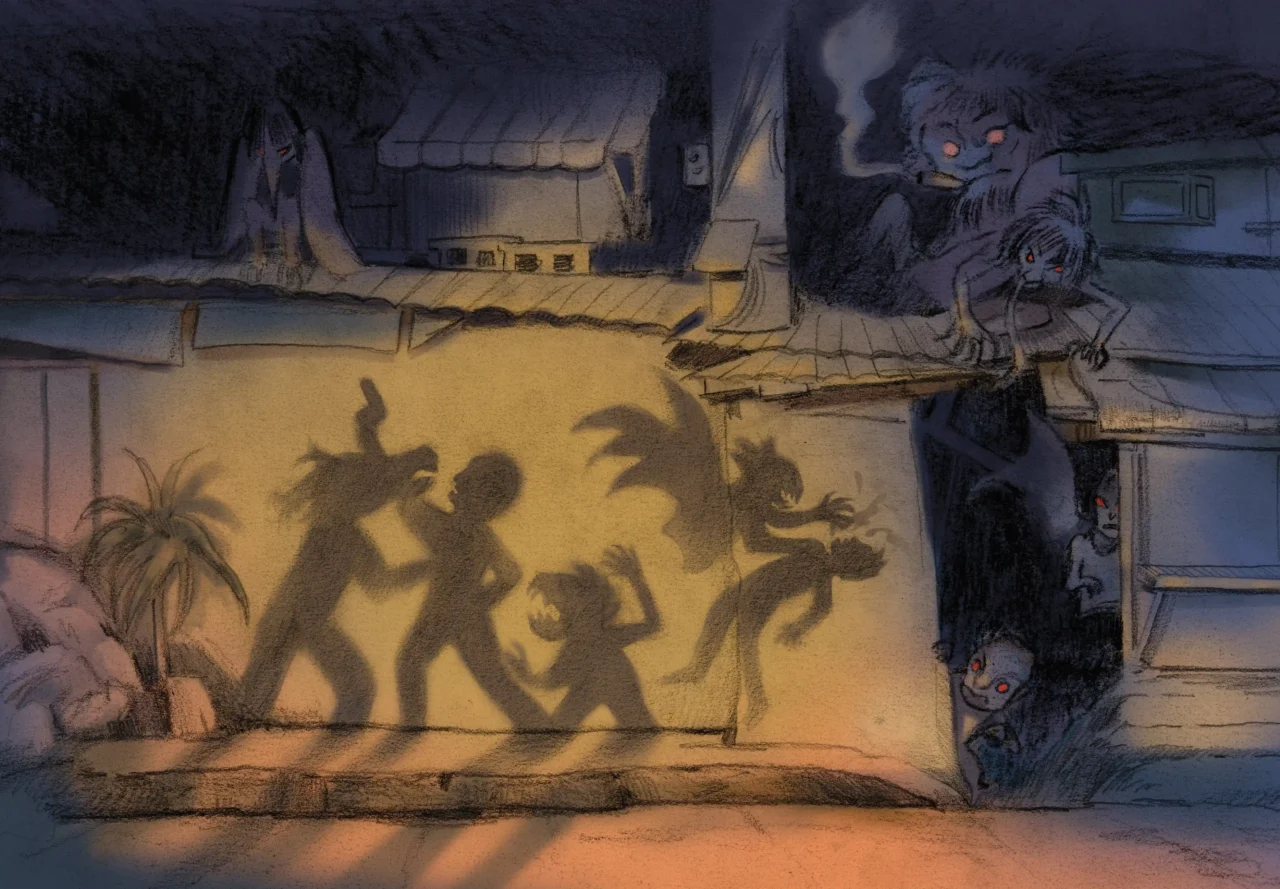
In 1962, Dr. Maximo Ramos became the first aswang academic after completing his PhD; he would go on to produce an authoritative body of work classifying and documenting aswang sightings throughout the archipelago. As Professor F. Lando Jocano notes in the foreword to Ramos’ 1971 handbook The Aswang Syncrasy, myths serve as a “medium of social control.” Fear and reverence for the unknown go beyond storytelling, but as Ramos suggests throughout his work, they may even inform how families traditionally built their homes, prepared their food, or treated outsiders.
Around the time the aswang phenomena began to receive academic attention, the first Filipino golden age of cinema began to dissipate. Due to compounding financial woes, once dominant local studios like LVN and Sampaguita fell by the wayside, clearing the way for smaller independent operations to flourish in the 1960s. Hemisphere Pictures, a Filipino-American co-production company, was founded by U.S. naval veteran-turned-producer Kane Lynn and future Filipino national artist Eddie Romero, and was best known for churning out exploitation horror flicks that catered to audiences transnationally.
Along with filmmaker Gerardo de León, Hemisphere produced releases that became cult classics and cemented the Philippines as a prime filming location for exploitation flicks for the rest of the 20th century. Films like de León’s Kulay Dugo ang Gabi (1964)—retitled as The Blood Drinkers for U.S. audiences in 1966—present a uniquely hybridized aswang figure. Though the film’s rather straightforward story, in which a vampire terrorizes a village in an attempt to revive his dying wife, is rife with references to the horror cinema found in the Western canon, de León’s film is firmly rooted in its rural FilipinoFilipinoThe national language of the Philippines, widely used for communication, education, media, and culture.Go to Filipino Glossary setting.
In the film’s opening, vampire Dr. Marco (Ronald Remy), fashioned like a bald-headed Dracula with sunglasses, emerges from the thick fog in a muscle car as he tails an ornate horse carriage. Riding into an abandoned chapel, Marco directs his entourage of henchmen to carry a coffin containing his dying wife Katrina (Amelia Fuentes) onto an operating table. As she is hooked up to whirring machines, adorned with flashing buttons and ticking meters, horror fans will already have picked up on several visual clichés endemic to the genre. From Bela Lugosi to Roger Corman, de León pays homage to filmmakers from across the Pacific.
One way to read de León’s film is as a product of Cold War neurosis. Malaysian scholar Gaik Cheng Khoo frames midcentury filmmaking across Southeast Asia as a political battleground between the capitalist West and the socialist East. For her, various U.S. agencies treated film “as a useful ideological tool in the fight against communism,” especially in the Philippines.
Mirroring horror and sci-fi narratives from Hollywood at the time, Marco can be read as a representation of the nefarious red-coded villain. A tragic romance may fuel Marco’s actions, but he is nonetheless the outsider enemy that threatens the local way of life. Mindless zombies, infiltrating extraterrestrials, or the blood-sucking vampire are all typical manifestations of Red Scare fear-mongering—otherworldly threats that seek to harangue or assimilate communities under foreign control.
In the film’s conclusion, townsfolk, officers, and clergymen band together to banish Marco from their community. As he vanishes into thin air, a protagonist’s voice-over recounts the aftermath of this incomplete triumph. They “knew that (they) would never catch (Marco), for who could trap the devil himself?” The conflation of the nocturnal creature with Satan is a framing that could only be produced by the localized version of Catholicism that has absorbed the aswang as part of its own mythos.
If exploitation horror flicks produced by companies like Hemisphere hybridized the aswang for dual audiences, the second golden age of FilipinoFilipinoThe national language of the Philippines, widely used for communication, education, media, and culture.Go to Filipino Glossary cinema would usher in another radical contribution to paranormal cinema.
Terror in the Camera
After working as the cinematographer on Lino Brocka’s Maynila sa Kuko ng Liwanag (1975), Mike de Leon made his directorial debut during the height of Martial Law with Itim (1976). Set during Holy Week celebrations, the film follows Manila-based photographer Jun (Tommy Abuel) who comes back to his provincial home in San Ildefonso to cover Easter processions and visit his wheelchair-bound father, Dr. Torres (Mario Montenegro). While photographing the locals at night, he has a chance encounter with Teresa (Charo Santos). Wandering around, seemingly in a fugue, she had walked from one town over and back without any recollection of the experience the following day. Roped into the supernatural mystery surrounding Teresa and her dead sister Rosa (Susan Valdez), Jun’s investigation leads him to a dark family history of his own.
Itim is an apt title, as the film is narratively and visually shrouded in darkness. It is in the locales where de Leon shoots, his most memorable frames dominated by dense patches of shadows, that the rancor of a forgotten violence hangs in the humid air. The setting of Jun’s family home is an intrinsically haunting one. Incidentally, this was de Leon’s own ancestral mansion, where he would later shoot the 2000 Jose Rizal mockumentary Bayaning 3rd World (an unconventional cinematic articulation of the ghostly chokehold our national hero continues to have on many Filipinos).
Jun, an outsider, is perturbed by everything from the gruesome killing of a chicken in an alleyway to masked penitents flagellating themselves on the road. However, it is in his own home where the photographer feels the most unsettled, cornered by religious idols and the isolating silence of midnight. Unlike its predecessors, the presence of the paranormal is only implied throughout most of the film, revealing itself fully only during the final possession scene.
We do not see an aswang creeping over the wooden balustrades or flying over the roof of the Torres household. A spiritista enables the protagonists to commune with the dead, but the supernatural elements of folklore stop there. The bone-chilling haunting which de Leon generates comes not from visualizing mythic horrors, but instead from the uncanny fears generated by absence and uncertainty. Like Jun, viewers wonder if there is indeed something hiding in the darkest corners of the shot.
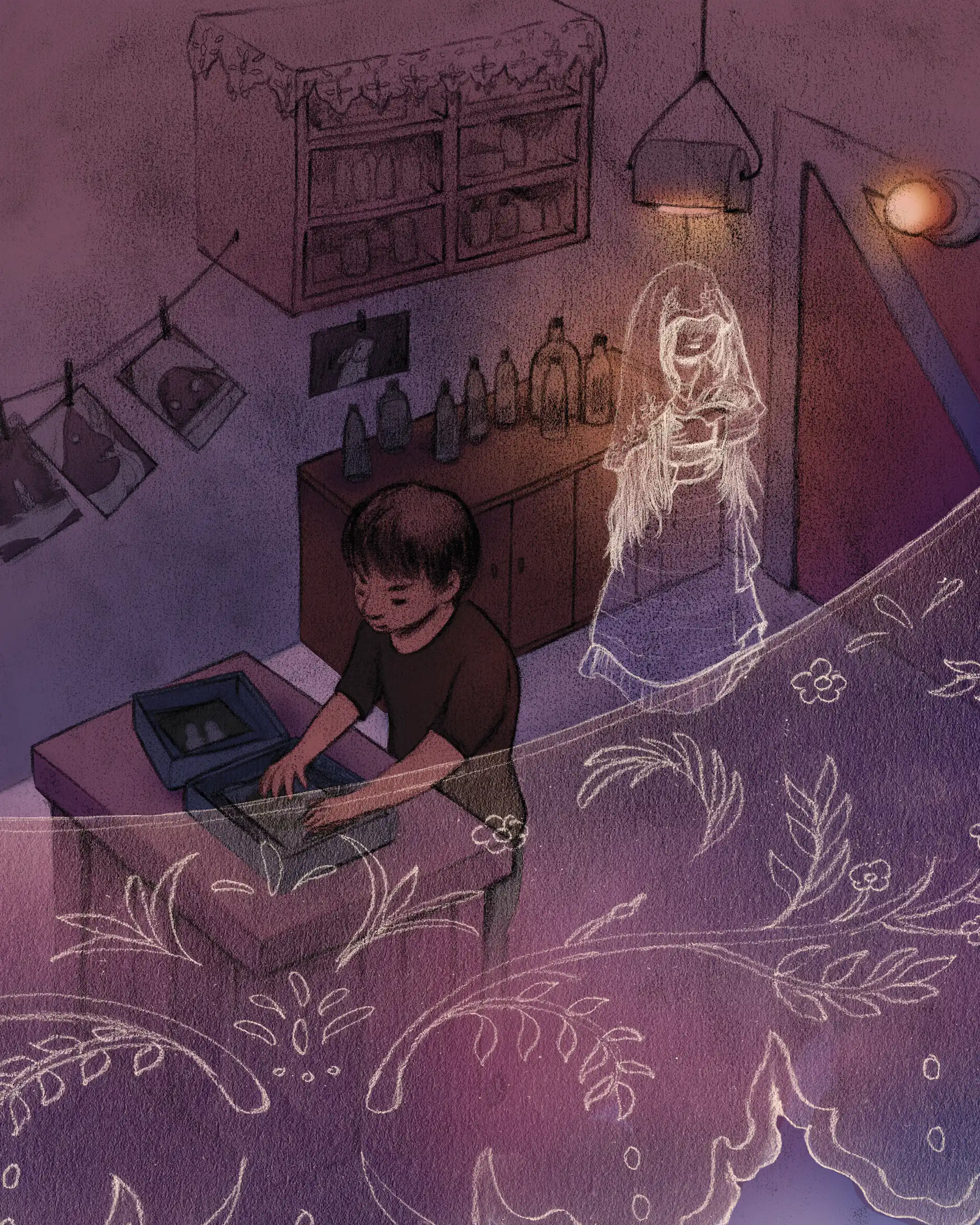
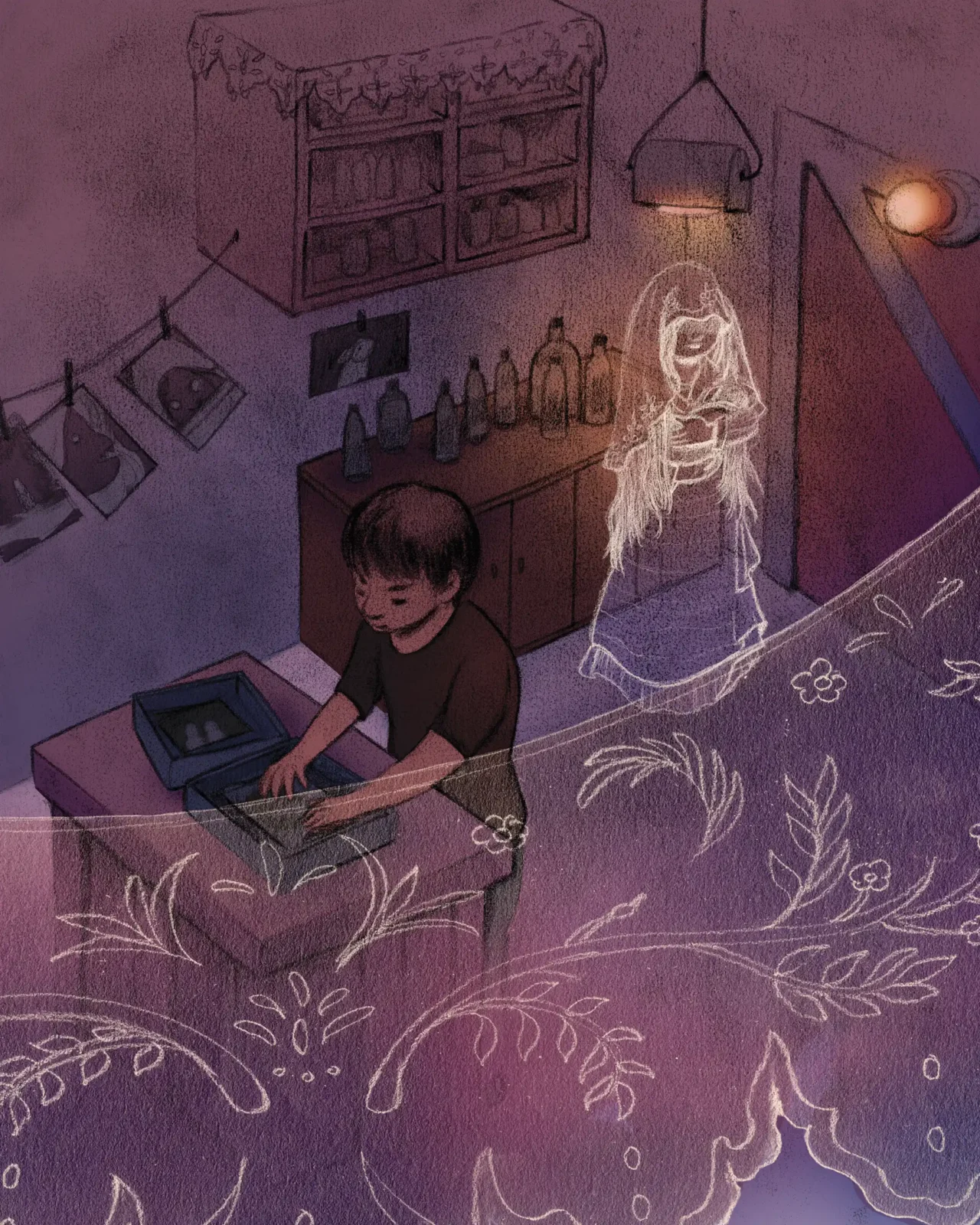
A scion of the LVN family, de Leon studied photography in Heidelberg before beginning his own career in film. Whether it was growing up around the operations of a major studio or during his time in Germany, Itim is proof that de Leon had a grasp of film’s ghostly qualities. In the film, it is through Jun’s work in his darkroom processing film negatives that the main clues pertaining to Rosa’s murder and his father’s transgressions are located.
In Itim, De Leon explicitly utilizes the film strip as a chemical-forensic tool. The negatives, which render any subject into a ghost-like silhouette, reveal traces of a repressed history. An original sin that might have faded into obscurity were it not for phantoms that remained etched onto the celluloid. The lingering presence of the paranormal would manifest in different forms throughout the decade that followed Itim’s release. In 1984, the first installment of the iconic Shake, Rattle & Roll anthology franchiseFranchiseA series of films, shows, or games built around shared characters and a shared universe, often spanning many sequels, spin-offs, and merchandise. Franchises dominate box offices and streaming, and theirGo to Franchise Glossary was released, a series that would not only become synonymous with Filipino horror but also a mainstay in the contemporary landscape of Filipino cinema. Part one was helmed by the directorial trio Emmanuel Borlaza, Ishmael Bernal, and Peque Gallega, but in the ensuing fifteen films spanning three decades, a whole host of filmmaking talent would contribute to the series’ compendium of socially attuned, supernatural tales.
Haunted by the Present
Since the dawn of the new millennium, FilipinoFilipinoThe national language of the Philippines, widely used for communication, education, media, and culture.Go to Filipino Glossary cinema has been beset by the forces of late-stage capitalism. Trade deals and a new onslaught of global capital reinforced Hollywood dominance. In the early 2000s, domestic studios attempted to cash in on the U.S.-driven fad of remaking Asian horror films. Film scholar Patrick F. Campos observed that in the first decade of the 21st century, the number of Filipino horror films “rose to nearly 70,” nearly triple the amount produced in the 1990s. Horror remains a prevalent genre in the mainstream market, but this trend only birthed cycles upon cycles of remakes and endlessly refashioned well-worn tropes.
As the paranormal FilipinoFilipinoThe national language of the Philippines, widely used for communication, education, media, and culture.Go to Filipino Glossary film reaches its centenary this year, it is easy to reflect on what has been lost over time. With the passing of Mike de Leon late last year, the bitter pull of nostalgia threatens to warp our collective vision. In recent years, thanks to the tireless work of Filipino film workers across the board, viewers can find some of the most exciting cinematic reinterpretations of the Filipino paranormal.
Alyx Ayn Arumpac’s 2019 documentary Aswang mobilizes a lineage of folk mythology and the visual language of horror cinema to deliver on-the-ground footage of Rodrigo Duterte’s bloody war on drugs. Following victims and photojournalists through the night, the film’s sparing use of a wry yet cutting voiceover uses the framing of superstition to confront the real violence of extrajudicial persecution perpetrated under the cover of darkness.
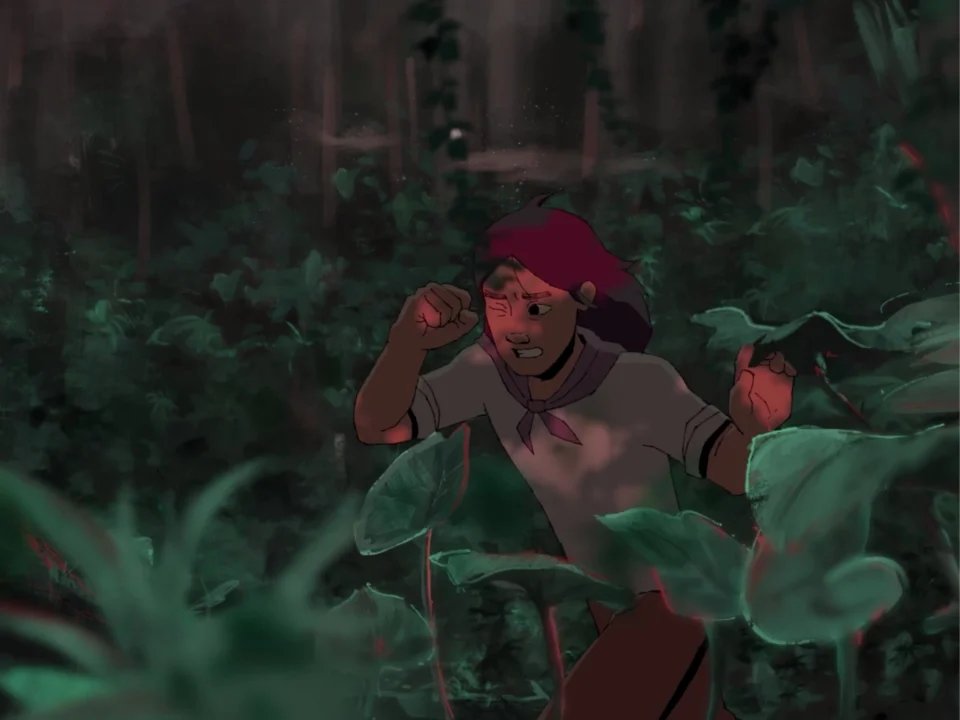
Another postmodern reinvention of a Filipino folklore creature can be found in Gabriela Serrano’s 2021 short Dikit. Taking the figure of the manananggal, a typically female-presenting viscera-sucker that is one of the oldest and most frequently used aswang caricatures, Serrano reforges Nepomuceno’s lost film for the modern day.
Using a split-screen format, mimicking the manananggal’s own severed corporal form, the “monster,” embodied by a young girl (Mariana Serrano), is compositionally isolated from a world dominated by patriarchal domestic norms. The spectral influences of world cinema—the vibrant gore of Italian giallo slashers, the transgressive experimentation of the New French Extremity, and the storied legacy of Filipino horror—bleed into one another, forming a singularly visceral visual language. Drenched in bright flares of natural light and erotic neon tones, the formal, physical, and social divisions in the film collapse in a liberatory reclamation of the female body.
The presence of the paranormal, whether it comes in the form of precolonial aswang archetypes or more abstract spiritual manifestations, has undoubtedly been an integral fixture throughout the history of Filipino-made moving pictures. In the century since they were first projected, silver screen creatures have reflected the tumultuous imperial, material, and cultural histories that have taken shape across the Philippines. Sigmund Freud famously characterized unresolved psychoanalytic mysteries and traumas as “unlaid ghosts.” One way to view our national preoccupation with the aswang is as a reflection of repressed traumas that continue to haunt the national psyche.
From the colonial era through the dictatorship years, the presence of specters mourns injustices that remain unanswered. Yet, as some of the most memorable films mentioned above demonstrate, the cinematic aswang is channeled as a progressive momentum. They frame the Filipino not as haunted by ghosts, but instead as bound by the phantoms who came before.
In the spirit of the Tagalog phrase “multo ng nakaraan” (the ghosts of our past), this rich tradition of paranormal cinema serves as a potent medium for reclaiming historical narratives and disseminating ideas that will shape the national future.
A version of this story appears in the November 2026 issue with the title “Celluloid Ghosts”
Frequently Asked Questions
Tiyanak (1926) and Ang Manananggal (1927), both directed by Jose Nepomuceno. All known prints appear to be lost.
A broad figure in Philippine folklore that includes creatures like the manananggal and tiyanak, long adapted and reimagined in Filipino films.
Released in 1976, it implies the paranormal rather than showing it, using darkness and film negatives to uncover a repressed history.
Alyx Ayn Arumpac’s 2019 documentary Aswang and Gabriela Serrano’s 2021 short Dikit, which reimagines the manananggal.