Summaries were generated by AI. Generative AI is experimental.
Explore other styles:
I sat at a corner table, pairing a perfectly crisp espresso, a flaky croissant, and an omelette with a view of Boracay’s beautiful blue horizon. But looking around, I noticed that the beachfront had transformed into an outdoor boardroom. The corporate dress code just happened to be linen, short shorts, and faces slathered with sunscreen.
To my left, a guy in a wrinkled white shirt fiercely negotiated a contract via Zoom (I’m good at eavesdropping). To my right, a girl in Lululemon sipped a cappuccino while reconciling a balance sheet on her MacBook Air.
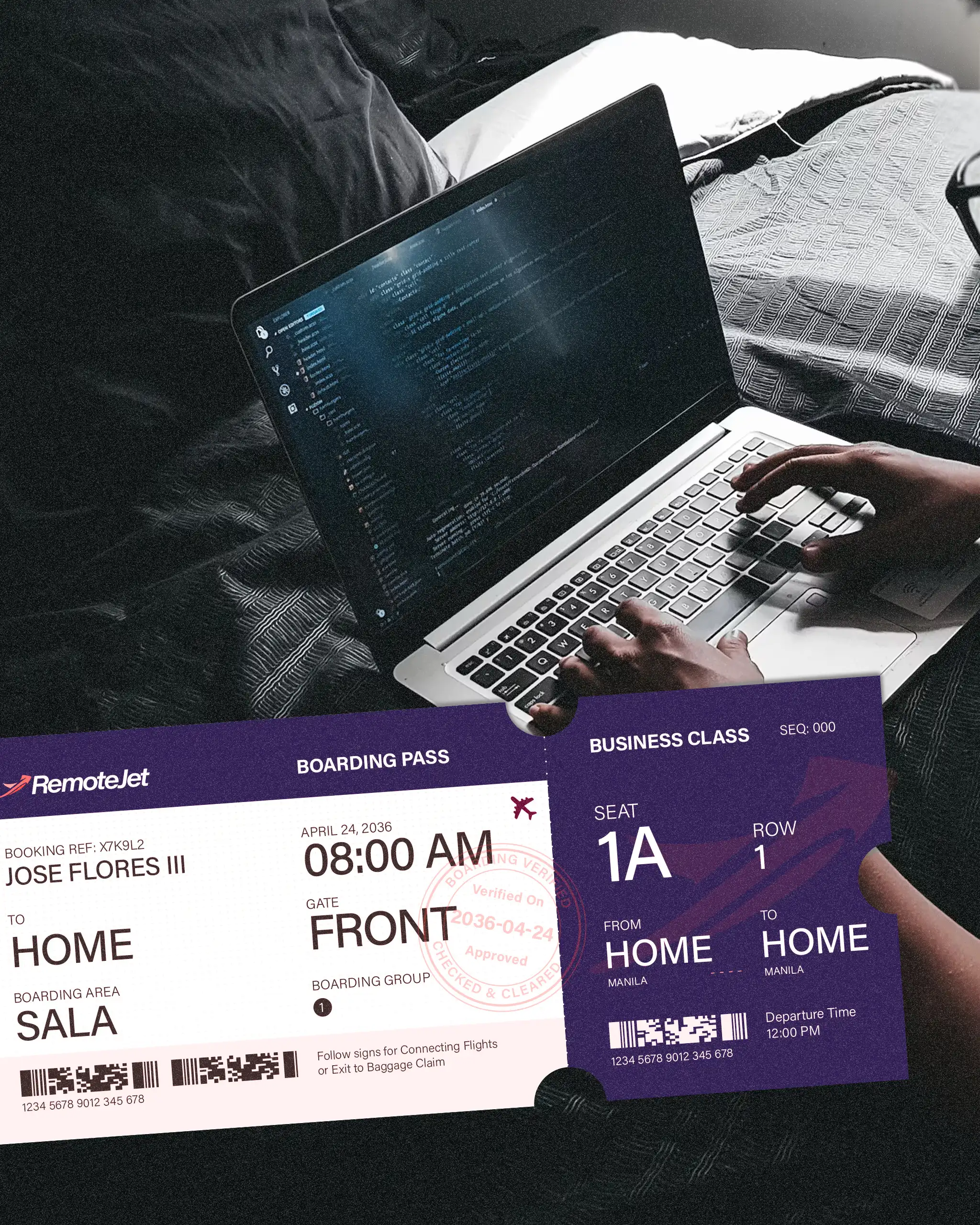
This is the new FilipinoFilipinoThe national language of the Philippines, widely used for communication, education, media, and culture.Go to Filipino Glossary digital nomad: working for companies thousands of miles away without ever leaving the country. For a growing number of professionals, the global workplace no longer requires a plane ticket. It requires little more than a laptop, a reliable internet connection, and a skill someone on the other side of the world is willing to pay for.
The New Dollar-to-Peso Dream
The math is simple. For a digital nomad living in Manila or across the archipelago, earning a foreign salary while paying in pesos is the ultimate economic life hack. Why endure the hostility of EDSA traffic or the soul-crushing bureaucracy of visa applications when you can pocket dollars from the comfort of home?
Take my friend Jiro. The 26-year-old UX designer abandoned his corporate desk job in Ortigas two years ago. Today, he designs for an e-commerce brand based in San Francisco. “My parents couldn’t grasp what these corporate job roles are,” he laughed over a cold brew. “Their idea of success is becoming an engineer, doctor, or a lawyer. They don’t even know what a UX designer does…It doesn’t matter. I’m happy with my decision. Success is staying exactly where I want to be.”
Jiro, like thousands of others, has rejected the traditional blueprint for a successful career. Instead, he mastered a niche global skill, learned to navigate complex project management tools, and successfully adjusted his biological clock to Western time zones.
Now, the workplace can be almost anywhere. Step into any specialty café across the country, or a beachside workspace in Siargao or La Union, and you’ll find professionals working for companies thousands of miles away. They don’t buy one-way tickets. Instead, they manage multiple digital bank accounts, curate slick LinkedIn profiles, and move money via Wise. If they board an international flight, it’s with a return ticket booked entirely for pleasure.
The lifestyle looks enviable on paper. You “own” your time, your Instagram grid is flawless, and your schedule mimics that of the independently wealthy. But the reality is an endless, highly calculated battle against structural elements that do not care about your deadlines.
Being a remote professional in the Philippines requires a redundant matrix of connectivity. The standard kit involves a primary fiber line, multiple local eSIMs to pit major telcos against each other, pocket Wi-Fi devices, and heavy-duty power banks. A sudden tropical blackout isn’t just an inconvenience; it’s a direct threat to your livelihood. There is a distinct, dry humor in watching a beachfront full of remote workers panic when a thunderstorm rolls in. This is a fragile form of freedom, dependent entirely on lithium batteries and signal bars.
The Passport Problem Nobody’s Instagramming
Here’s the truth nobody admits on their carousel posts: not all digital nomads are created equal, and the visa stamp proves it.
During a recent stretch in Sydney, I ran into digital nomads whose careers sounded entirely made up. They moved across borders on arrival visas that took fifteen minutes to secure online, disappearing to Thailand whenever they needed to “reconnect with their spirit guides.”
It’s a tough pill to swallow. A FilipinoFilipinoThe national language of the Philippines, widely used for communication, education, media, and culture.Go to Filipino Glossary professional earning the same dollar rate may not have the same freedom. For us, an international trip is planned like a military operation. Our passport demands bank statements, income tax returns, and consulate appointments just to prove we can afford the journey. Same income, wildly different global mobility.
There is another uncomfortable contradiction in all of this. The same foreign purchasing power that gives FilipinoFilipinoThe national language of the Philippines, widely used for communication, education, media, and culture.Go to Filipino Glossary digital nomads a better quality of life can also make places like Bali or Siargao feel artificially cheap. It is easy to romanticize a P500 lunch when you are earning in dollars, even if the person serving it is earning in pesos.
I think about that dynamic often, usually when it is least convenient. Earning in foreign currency while living in a developing economy is a massive financial win. Yet, the woman clearing my breakfast plate earns a local minimum wage that this economy decided was enough for her, but would never be enough for me.
Foreign purchasing power doesn’t inherently make life simpler; it just introduces a new layer of existential friction. No amount of artisanal oat milk lattes can change that geopolitical math.
The Price of Paradise for a Digital Nomad
A sobering truth emerges when you look past the postcard aesthetics. The freedom of the digital nomad comes with its own contradictions. You can escape the office without escaping work, earn more without necessarily feeling richer, and live in paradise while remaining tethered to a laptop.
This lifestyle is frequently touted as the future of work, a career where success is measured in autonomy rather than a corporate corner office. But let’s be completely honest about the reality glitch nobody puts on their social media grid: most digital nomads never actually escaped the rat race. We just gave it a sunny view, better air quality, and artisanal meals. Whether you are crossing an ocean or sending data through the ether, it is still the same wheel. We have simply repainted it turquoise.
And yet, there is an undeniable upside to all of this. We can now participate in the global economy without necessarily being physically separated from the communities we call home. The hustle remains global, but the community stays local.
For now, I will happily take this version of paradise. I sit by the cerulean waters of Boracay, wearing linen, overpaying for a “reimagined” local dish, and feeling entirely content. But as the afternoon rolls in, a familiar anxiety creeps back. Somewhere in the back of my head, I am already brainstorming a brilliant excuse to tell my foreign manager about why I missed that 10:30 a.m. Zoom invite.
Frequently Asked Questions
A Filipino digital nomad is a professional based in the Philippines who works remotely for companies abroad, earning a foreign salary while living and paying expenses in pesos. Common hubs include Manila, Siargao, La Union, and Boracay, where cafés and beachside spaces double as workspaces.
Earning in foreign currency while living in the Philippines lets remote professionals benefit from favorable exchange rates and a lower local cost of living. It allows them to work for companies in markets like the US without relocating, avoiding visa sponsorship and higher costs of living abroad.
Remote workers in the Philippines often rely on a primary fiber line, multiple local eSIMs, pocket Wi-Fi devices, and power banks to stay online. Tropical blackouts and storms pose a direct risk to their livelihood, since work depends entirely on consistent internet access and power.
No. Filipino passport holders typically face stricter visa requirements, including bank statements and consulate appointments, even when traveling with comparable dollar income to nomads from countries with more powerful passports. This creates a mobility gap despite similar earning power.
Earning in foreign currency gives Filipino digital nomads outsized purchasing power in lower-cost areas like Siargao or Bali, making everyday expenses feel cheap relative to their income. This can also widen the gap between their spending and the local wages of the communities they live in.

James Fergus Arevalo
James Fergus Arevalo is a writer for GQ Philippines, blending the rigorous mind of a data scientist with a passion for modern grooming, lifestyle, and culture. When he isn't writing, he spends his time meditating, painting, and exploring the deeper questions of life. He holds a degree in Biology from Ateneo de Naga University and has a deep curiosity about human potential. You can contact him at [email protected].
- KEYWORDS
- Digital Nomad