Summaries were generated by AI. Generative AI is experimental.
Explore other styles:
“The centipede is a friend of the warrior,” Grace Palicas tells me, balancing two sticks in her hands. At the end of one is a pomelo thorn dipped in a dark ink of soot and water. With the other, she strikes it repeatedly, driving the pigment beneath my skin. The sound is small and wooden—tap, tap, tap—but the sensation is astonishingly sharp.
Having accumulated more than enough tattoos, I thought I understood that all I had to do was remain still and breathe evenly. But batok is different. Each strike feels distinct. Unlike the gliding needles of a machine, the thorn repeatedly reopens the exact same narrow path through the flesh. The session lasts only an hour, yet it is the most painful tattoo I have ever received.
While batok is often translated simply as hand-tapped tattooing, the description flattens a complex intersection of technique and inheritance. Historically, these markings signified beauty, fertility, protection, rank, achievement, or rite of passage. Among men, specific tattoos were earned through acts of warfare and honor. Among women, extensive markings were a celebrated sign of beauty and desirability.
Now, a geometric centipede was taking shape on my arm. I felt like a poser. I was no warrior.
Grace, who gave me my tattoo, began learning the art at the age of nine. While other children her age played outside, tattooing was her own form of play. She was the first child of her generation in Buscalan to be trained by Apo Whang-Od, the legendary tattoo artist who is her grand-aunt, mentor, and predecessor. Later joined by her cousin, Elyang Wigan, the three women became the most recognizable faces of an ancient practice. It is a tradition that has survived colonial rule, missionary disapproval, shifting standards of beauty, and the decline of the ritual warfare with which men’s tattoos were once inextricably entwined.
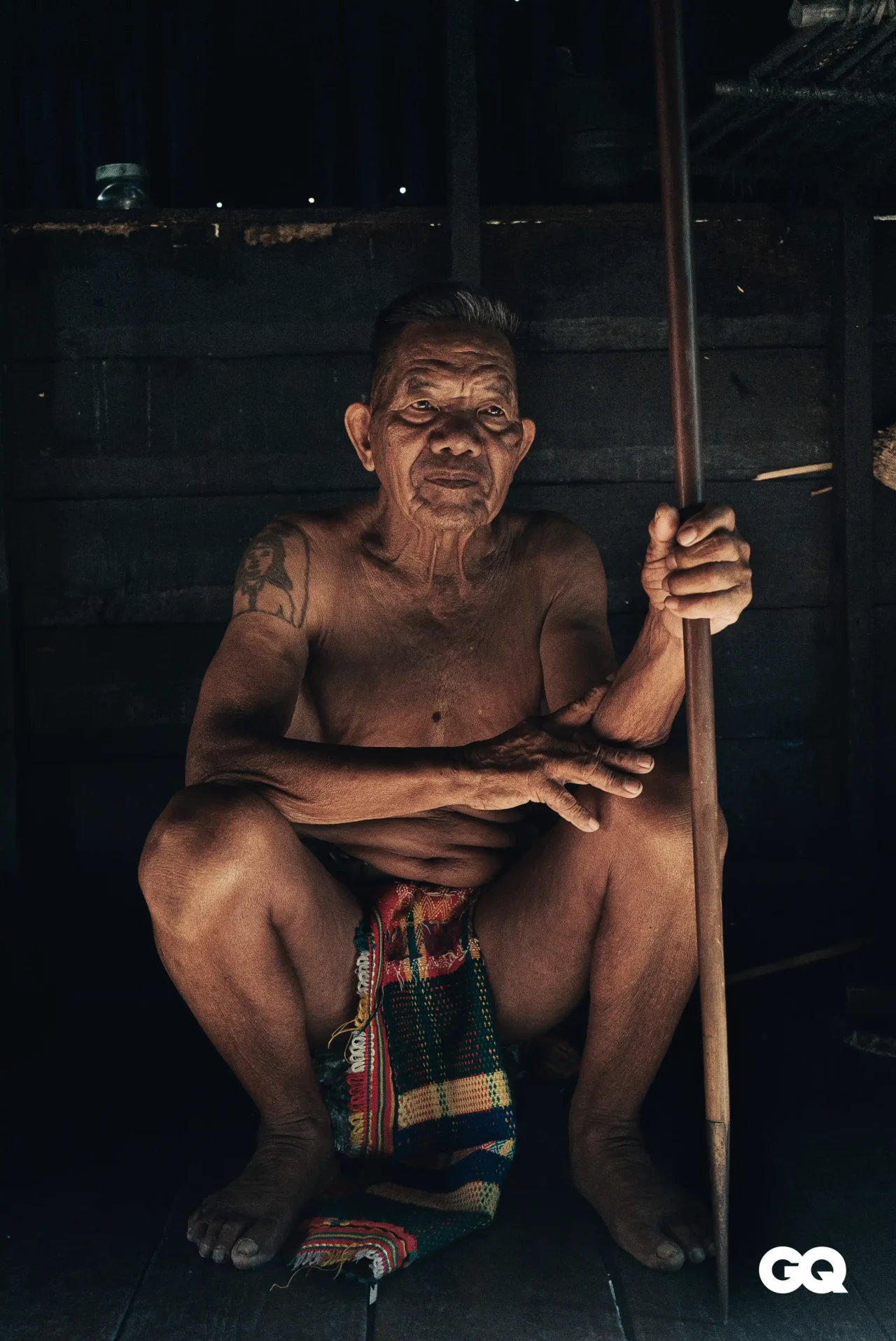
Not long after my session, I stood face-to-face with Grace’s grandfather, one of the few remaining male elders in the village carrying the markings of an older Buscalan. When we first met, he appeared unassuming—quiet, compact, and elderly. His presence did not immediately announce the history written across his body, but he agreed to show us his tattoos.
He changed into ceremonial clothing and a bahag, returning with a spear and a blade he had forged himself. The room shifted. Perhaps it was the weaponry, or perhaps the sudden realization that the objects were not decorative, but vital extensions of knowledge once necessary for survival. The grandfather who had stood quietly before us moments ago now seemed to occupy the space with a different gravity.
On his shoulder was the image of a human face; on his forearm, a centipede.
His centipede was weathered, its black lines softened by decades of sun and labor. Mine was swollen and freshly inked. The resemblance between them was superficial. His tattoo belonged to a life, a community, and a system of meaning that I could approach only as a visitor. Mine had been selected from a menu of patterns pre-approved for outsiders.
When I asked him about the markings, he did not answer. Instead, Grace’s mother—our guide and translator, whom we called Nanay Abs—began speaking of slain relatives, unresolved debts, and revenge. She described cousins and brothers lost in inter-communal conflicts. In the moral logic of her stories, a death created an imbalance that demanded correction. “Kung buhay yung inutang mo, yun ang ipagbayad mo [If what was taken was a life, then a life was the payment],” she said. The face on the elder’s shoulder was not merely a face.
Nanay Abs did not need to detail everything that followed; the implication was enough. The centipede, meanwhile, represented protection as a guardian and companion of the warrior. Tattooing was never a cosmetic embellishment applied after the fact. It was a ceremonial recognition of what a man had done, and what he had become.
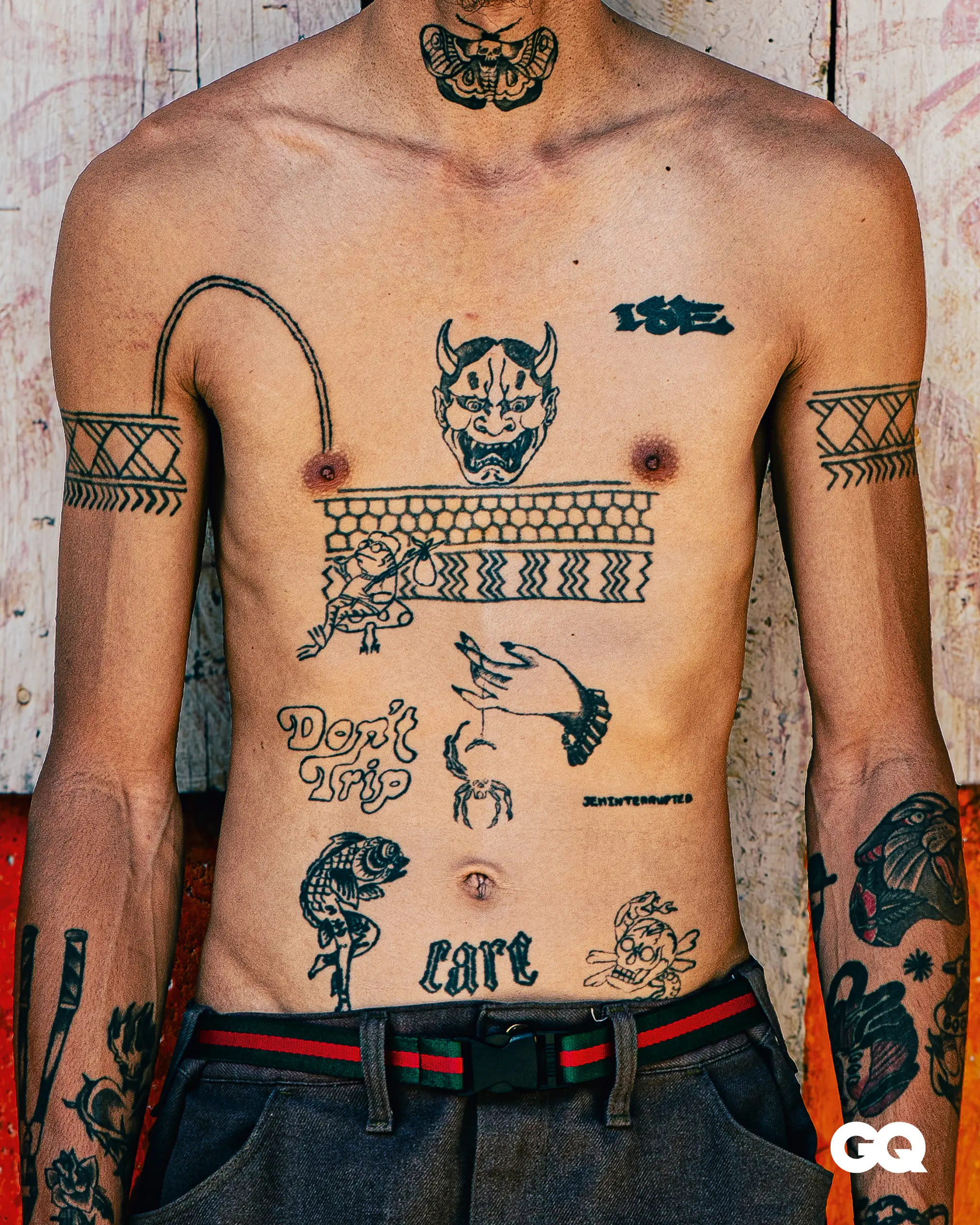
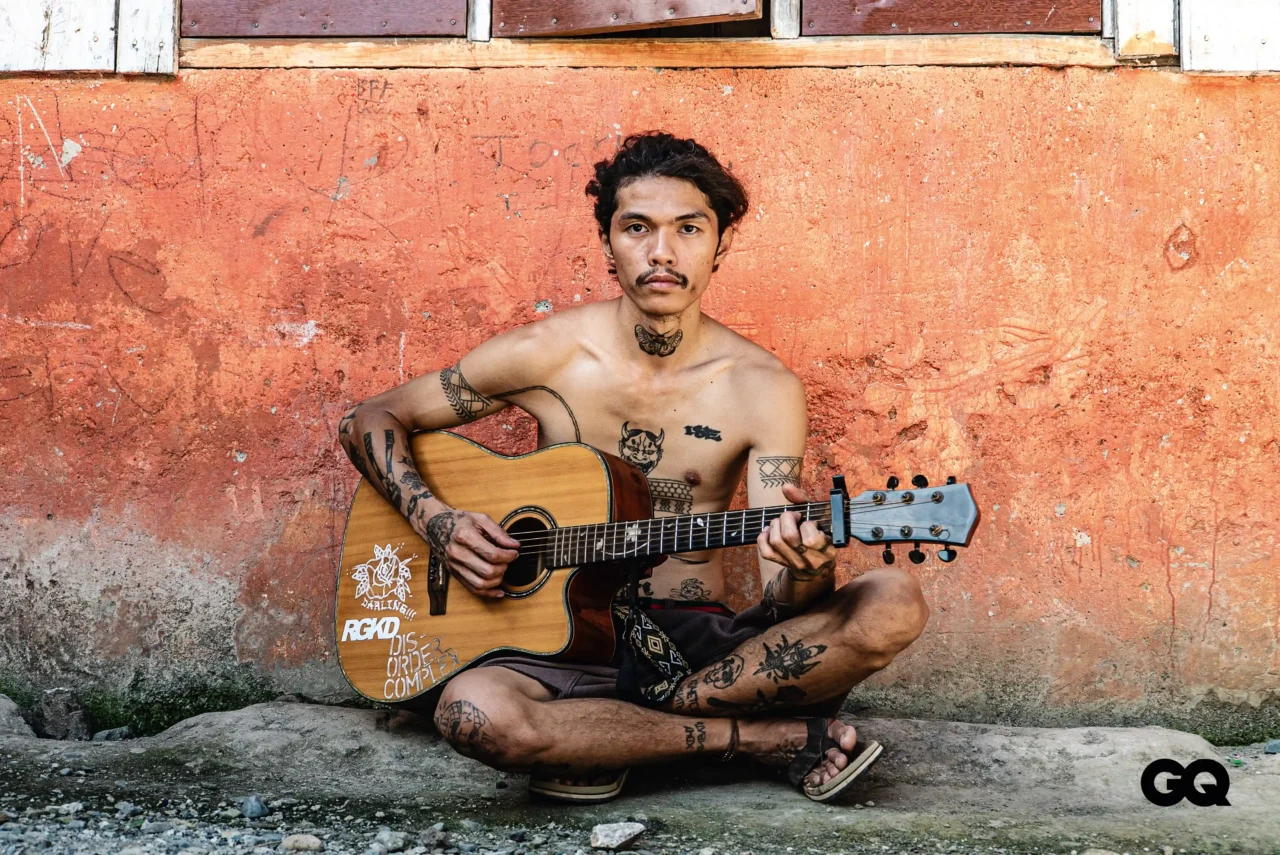
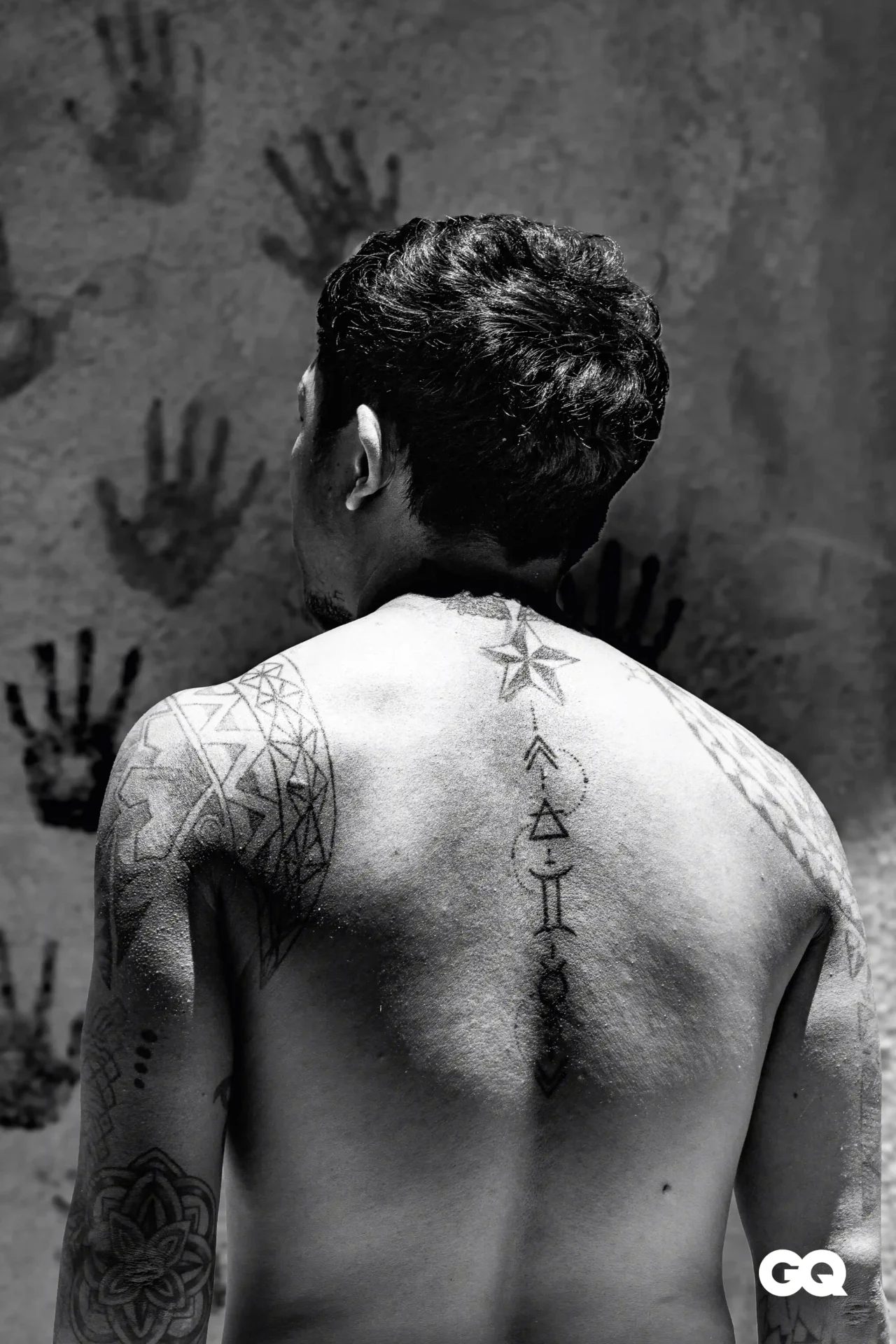
Today, the village presents a radically different landscape. Buscalan is crowded with ink. Tattoos appear on visitors waiting outside homes, on guides navigating steep concrete pathways, and on young artists carrying their tools from client to client. There are black geometric armbands, centipedes, snakes, scorpions, crabs, rice bundles, suns, and moons. There are even machine-made tattoos in contemporary styles and colors, brought back from Manila and other cities. Yet amid this explosion of ink and the constant piercing of skin, male tattoo artists remain strangely elusive.
Grace estimated that only a handful of men currently practice in the village. One man we approached was too shy to be photographed and declined an interview. The other, John Rey Tiggangay, was a recent graduate who had already been tattooing for several years.
Tiggangay was soft-spoken, answering my barrage of questions with measured, understated replies. Apo Whang-Od, he noted, had briefly helped train him. His first practice subject was his mother, whom he tattooed a scorpion when he was around 16 years old. On his own body was the number seven. Why seven? He did not know. Apo Whang-Od had simply given it to him.
He works exclusively in batok rather than with a machine. He favors the sun and moon motifs, though he finds armbands among the most difficult patterns to execute. He has traveled with other local artists after receiving invitations to tattoo in Davao, Manila, and Tagaytay. When I asked how he felt about belonging to this new generation of practitioners, he did not frame it as a grand cultural responsibility. Tattooing was simply something he liked, and something he was good at.
His restraint reflected a broader pattern among Buscalan’s men. Despite living in a village globally synonymous with tattooing, they were generally less heavily tattooed than the women. This contrast is rooted in the traditional division of cultural meaning. Women could be marked for beauty, but men had to earn their tattoos.
Grace explained that tattooing is still widely perceived in Buscalan as women’s work. She hoped the younger male artists were practicing to preserve their heritage, though she also recognized the undeniable economic lifeline that tourism has become.
The historical reversal is striking. During Apo Whang-Od’s youth, Grace said, tattoo artists could be male or female; the person who marked Whang-Od was a man. But as that generation passed away, Whang-Od became the lone custodian of its traditions. What had once been a field with many men passed through the hands of one surviving woman.
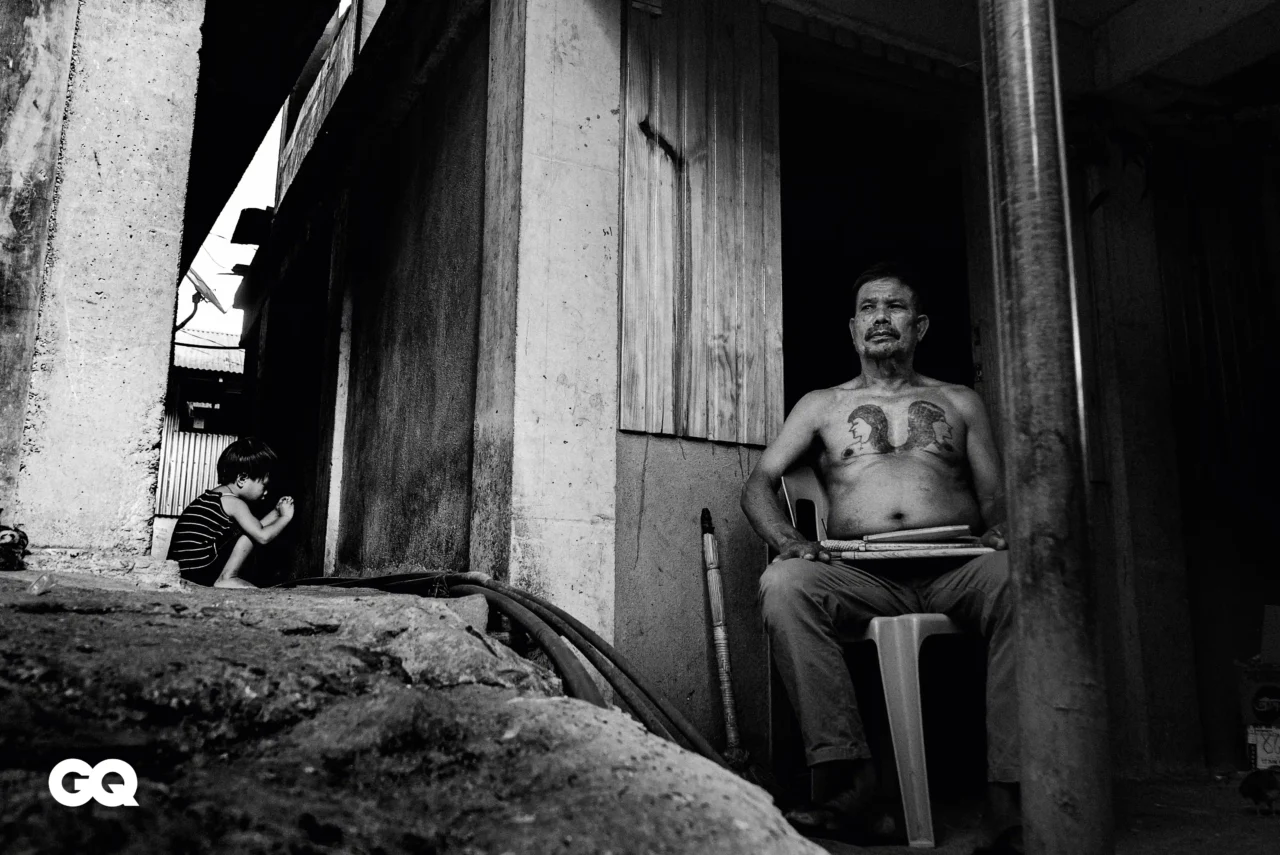
The sacred weight of men’s tattoos has faded as a new generation has redefined village life. Khent Paclay received his first tattoo in the sixth grade while Elyang was practicing. To his generation, he said, tattooing has evolved into an art form. In the past, a man did not simply decide he wanted ink. “Pag may napatay ka, saka ka lang magpatattoo [Only when you’ve killed someone, that’s when you can get a tattoo],” he said—explaining that only after fighting in a tribal war could a man be tattooed as a symbol of his status as a warrior.
Now, he continued, it is a matter of personal choice. This freedom has altered not only who may wear the markings, but also how the craft itself is passed down. While Grace and Elyang were trained strictly within Apo Whang-Od’s bloodline, a broader, informal tattoo culture has bloomed around them. Young villagers watch the masters, mimic their movements, and practice on themselves, relatives, and friends.
“Sila-sila lang [It’s just them],” Grace said of many of the newer practitioners. They are entirely self-taught. Several of them began astonishingly young—at 12, 13, or 14 years old. In Buscalan, the knowledge feels simultaneously guarded and ambient. The recognized inheritance remains attached to Apo Whang-Od, Grace, and Elyang, but the practical vocabulary of batok circulates through the village by sight, repetition, and skin.
Not every design tapped into a visitor’s skin is ancient, nor does every symbol retain a single, immutable meaning. Today, outsiders choose from a fixed menu and project personal meanings of strength, guidance, or remembrance onto the ink. A single image can operate simultaneously as an ancestral sign, a tourist souvenir, an aesthetic choice, and a vital source of income. Tourism has woven these contradictions into an inseparable reality.
Grace remembers when the earliest visitors were mostly foreigners and domestic tourists arrived in much smaller numbers. Around 2014, however, the crowds began to swell. What she, Apo Whang-Od, and later Elyang could once manage themselves quickly evolved into an endless stream of bodies. Previously, the three women would tattoo perhaps one vanload of people over a day or two. Now, more than 10 vans might arrive in a single day.
This influx transformed the village. Farming was no longer the only available livelihood. Homes became homestays. Residents became guides, organizers, translators, and tattoo artists. Concrete and metal have replaced traditional building materials.
One tattoo tourist I met, Zavien Lee, had watched years’ worth of videos about Apo Whang-Od before making the journey. He scoured YouTube, Instagram, and obscure clips with only a handful of views, essentially watching Grace grow up online before even meeting her. Once in Buscalan, he received tattoos from Apo, Grace, and Elyang.
“I had to get all three,” he explained. Yet even after exhaustive research, Zavien noticed a glaring absence. There were almost no interviews with Buscalan’s men, and the cameras remained fixed, understandably, on Whang-Od and the women carrying her legacy forward.
Perhaps this is because male tattoo culture in Buscalan is caught between two worlds. The older world gave men’s tattoos immense weight but permitted them only under extraordinary circumstances. The new world has made tattooing universally accessible while loosening the meanings that once made those marks necessary. Today, men are now free to be tattooed without being warriors, yet many wear far less ink than the village’s women. They are free to learn batok, yet few choose to practice it publicly.
On my arm, the centipede has healed.
It no longer throbs. Its lines have settled into the surrounding tattoos, another black figure among many. Yet I keep returning to the image of Grace’s grandfather: his handmade blade, the face etched onto his shoulder, and the faded centipede tracking down his forearm.
We wore the same creature, but not the same tattoo.
His belonged to a history he had lived and inherited. Mine was a sign of having been welcomed, however briefly, into a community generous enough to share its tradition with a stranger. Marks once reserved for those who defended their culture now travel outward on the skin of outsiders. The centipede may be remembered as a friend of the warrior, but in Buscalan today, it also bears witness to continuity—a pattern passed carefully from one generation to the next, retaining traces of the past while finding new meaning in the present.
A version of this story appears in the September 2026 issue with the title “The New Ink Order”
Frequently Asked Questions
Batok is a traditional hand-tapped tattooing technique from Buscalan, Philippines, using a pomelo thorn dipped in soot-and-water ink, struck repeatedly with a stick to drive pigment into the skin, distinct from machine tattooing.
Apo Whang-Od is a legendary, elderly tattoo artist widely regarded as the last practitioner of her generation trained in traditional batok tattooing. She trained her grand-niece Grace Palicas and, later, cousin Elyang Wigan, who now carry the tradition forward.
Traditionally, men’s tattoos, including designs like the centipede, were earned through acts of warfare and represented protection and rank. Women’s tattoos were more extensive and represented beauty and desirability, a distinction rooted in the village’s traditional division of cultural meaning.
Historically, men had to earn tattoos through acts like tribal warfare, while women could be tattooed for beauty. As ritual warfare declined and tattooing became a personal choice rather than an earned status symbol, fewer men chose to get extensively tattooed compared to women.
Tourism to Buscalan grew significantly starting around 2014, transforming the village economically as farming gave way to homestays, guiding, and tattooing as primary livelihoods. Visitors now choose from a fixed menu of designs, blending ancestral symbolism with personal meaning and tourism income.