Summaries were generated by AI. Generative AI is experimental.
Explore other styles:
Being in a rock band is intense. You grind night after night at every humid dive bar, chasing dreams with your best friends, all hoping to catch that big break. It’s easy to forget to take care of your health between the sweat, flashing lights, and beers.
One day, you might find yourself unable to play because your ankles gave out, and it feels horrible—not just because of the injury, but because you can’t do what you love most for weeks, or worse, permanently. Scary, right?
The good news is that you can train your body to keep doing what you love for longer. And because each musician puts different demands on their body, each band member has specific areas that need extra attention. Just like being in a band, everyone needs to be at the top of their game to cut through the noise.
The Frontman/Singer
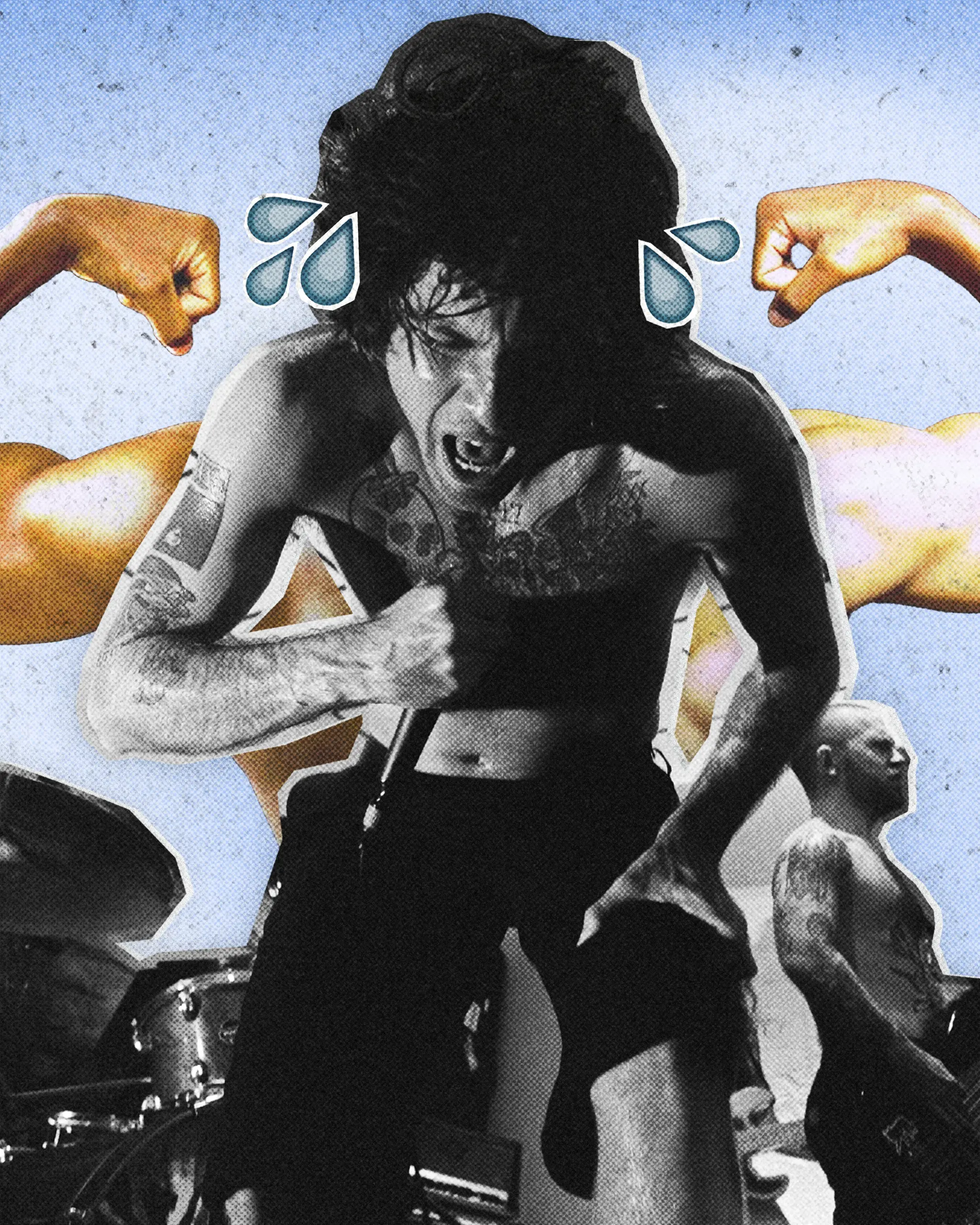
A rock singer’s most important contribution isn’t just singing well; they’re also expected to be an engaging showman. Frontmen need to harness the electricity of the entire band, acting like a funnel to channel it toward the crowd.
If you’re not getting your endurance and cardio in, you’ll likely be tired by the end of the third song, and if your legs are not strong enough, continuous jumping will leave you with knee and ankle pain for months.
At 78, the legendary Rolling Stones frontman Mick Jagger’s training to keep going is to “move very quickly and then you stop. And then you walk.” You may not have the moves like Jagger, but you can do some high-interval sprints followed by brisk walking to train your lungs for the highs and lows of being on stage.
Additionally, you can do lower-impact incline power walking to build endurance in your legs without exhausting your lungs too much, all so you can practice proper breathing technique. The audience will thank you for not breathing heavily on the mic.
The Guitarist/Bassist
There’s a lot of care and craftsmanship that goes into making an electric guitar. But no matter how pretty it is, it will spend most of its time strapped to your shoulders, and that constant load on one side might mean you’ll eventually find yourself standing lopsided when you take it off.
The wonderful pull-up hits two birds with one stone: it helps your upper body carry the weight of your massive talent (the guitar), while also strengthening your core for moves like a guitar spin.
Chicosci bassist and Bird. frontman Eco Del Rio makes it his mission to do daily pull-ups and is nearing a year into this journey. He may not be specifically doing it to carry his guitars better, but it definitely helps, especially when performing in two or more bands every night.
Pro Tip: No matter how strong your shoulders are, it helps to buy a leather or neoprene strap to better distribute your instrument’s weight. And don’t do pull-ups before a set, unless you want your wrists too fatigued to pull off even a measly power chord.
The Drummer
Don’t be mistaken: despite being seated for the duration of a set, the drummer is arguably the fittest member of the band, bar none. They’re essentially exerting the same physical intensity as a professional athlete.
Before becoming the frontman of one of the biggest punk bands right now, Turnstile, Brendan Yates was a drummer for Baltimore legends Trapped Under Ice. In the hardcore scene, being jacked is as synonymous with the culture as screaming your lungs out about authoritarian figures. To become a great drummer in this genre, you’d need biceps and quads for days, while having enough core strength and cardio to keep that lightning-fast momentum behind the kit for 30-60 minutes.
Therefore, the drummer routine is a complete workout package: build biceps with hammer and dumbbell curls, strengthen the core with goblet squats and planks, work the quads with leg extensions and dumbbell lunges, and finally, do some sprinting or even use a stationary bike to simulate the demands of cardio while sitting down.
While the goal is to build muscle and look good, the true endgame of working out is to keep doing this for a long time, because music as a career is one of life’s many blessings you need to cherish. So if you can somehow fit any of these exercises into the chaotic life of a showman, then that’s better than nothing at all.
Frequently Asked Questions
Each role puts different physical demands on the body, from a frontman’s stage cardio to a drummer’s full-body endurance.
Cardio and leg endurance, like high-interval sprints and incline power walking, to handle jumping and breath control on stage.
They build upper body strength to carry the instrument’s weight and strengthen the core for stage moves.
Drummers use biceps, quads, core strength, and cardio simultaneously, similar to the demands placed on a professional athlete.
At 78, Rolling Stones frontman Mick Jagger described his approach as moving very quickly, then stopping to walk — a rhythm band frontmen can mimic through high-interval sprints followed by brisk walking.

Ethan Cardaño
Ethan Cardaño is GQ Philippines’ News Writer, bringing the latest in everything men to the forefront. If he’s not actively looking for stories, you’ll find him trying on trending menswear pieces, watching films in cinemas (as intended), frequenting local gigs, and eyeing everything counterculture. Before joining GQ Philippines, he graduated with a degree in Journalism from the University of Santo Tomas (UST), where he served as a photojournalist and eventually became chief photographer for The Flame, the official student publication of the UST Faculty of Arts and Letters. You can contact him at [email protected].